09 — 12.05.2026



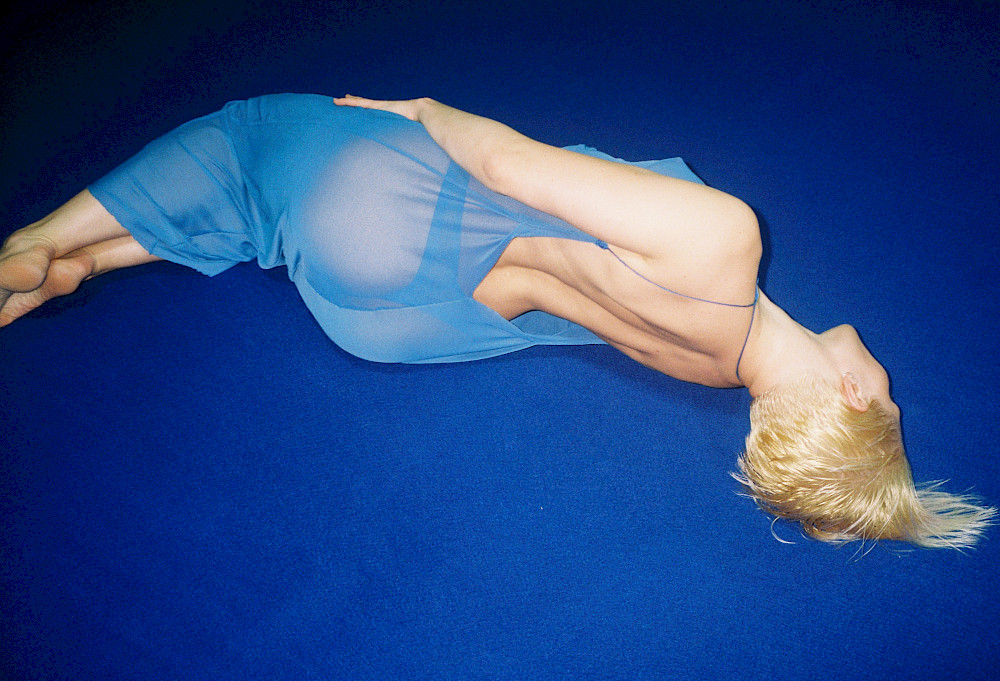
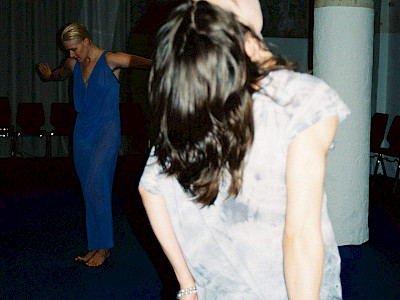
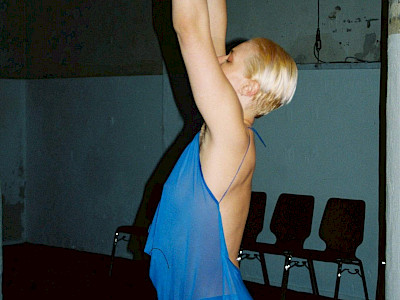
A thick, ultramarine blue carpet covers the entire space. Dionne Warwick sings What the World Needs Now on repeat. Dressed in blue, Ewa Dziarnowska and Leah Marojević dance in the middle of the space, ebbing and flowing. Generous and attentive, they play with attraction, repetition, form, and feeling. It is a choreographic exploration of physical desire and longing, hope and loss. They challenge each other, dancing solo and in duet, sometimes in sync. They make contact with each other, and occasionally with the audience. Because the dancers come so close, it breaks the viewer's passivity. Watching becomes moving, and moving becomes a form of being seen, a reciprocity that undermines classical performance.
Dziarnowska sees improvisation and embodied knowledge as counterparts to our need for rationality and linearity. She develops projects that are equal parts installation and performance, replacing the consuming gaze with a transformative encounter. Dance becomes a space where time is suspended, and complexity is given a place, a connecting practice through an erotic presence. This resting, patience is a celebration of desire and sensuality, with exceptional virtuosity and emotional build-up, showing how dance can save us in dark times.
"At once disconnected from the promise of sex and the fear of insecurity, sensuality is not only celebrated through dance and the dancers’ bodies. It also manifests in the generous and open pleasure between dancer and viewer that is created through a mutual awareness of each other's presence. (...) Exactly what the world needs at the moment.", Wendy Lubberding, 2024, Theaterkrant
Witnessing the full experience is recommended, but you can freely leave and re-enter if necessary.
Conversation between Ewa Dziarnowska and Kerstin Schroth about This resting, patience
Kerstin Schroth – Ewa, This resting, patience is a long durational work, can you tell us about your desire to create the performance?
Ewa Dziarnowska – I wanted the dance to be seen from up-close, in a more raw, “bare” form. In my studio practice, I relate to dance a lot as something pleasure- or sensation-driven, or as a coping mechanism. A particular space of its own, with its distinct integral logic and onto-
logy, that I like to spend time with. It’s a way of knowing, of dialoguing with oneself and everything around.
I very much wanted that dancing in This resting, patience does not become instrumentalized to mean this or that, that its shape and form are not confined by the reductive dictates of dramaturgy or concept-making. The desire of exploring dance relatively free of pre-set choreography, made “installation” as an idea sound appealing. From there, it took the shape of a hybrid event where dance could function more as a sculpture. That way of thinking gave us the freedom to attend to dance’s materiality and texture—its poetic dimension—rather than logical progression, narrative or semantics. It’s as if in the work, we’re not making meanings, but we’re making moments.
Another aspect we’ve been exploring, that adds on to that, is how proximity creates engagement and obfuscates critical distance. I wanted the dances to be simultaneously seen from up close and far away. To place the spectator within the sphere of address and at the edges of the room, so both modalities of watching can be experienced, and chosen between, throughout the three hours.
The long duration is an important aspect that creates and reveals subtleties, nuances, complexities. Eventually, through repetition, the audience starts to receive the work differently. You pay attention not only to what is happening, but how it is happening and what relations and practices are at play. You’re watching a practice, a real-time negotiation rather than a (re-)production.
Throughout the performance, the song What the World Needs Now by Dionne Warwick reappears repeatedly. I am curious to hear what inspired you to choose this song?
I would say it was more of a discovery than a choice: the song, which is just a song I listened to and played a lot in the studio, inspired the dance. It was then a choreographic decision to loop it many times in its entirety, keep our stationary positions, work with a circle of chairs around us.
When I work, I don’t start from a pre-conceived idea, from a concept, for which I try to find suitable material. But instead, I look at what it is I’m already doing. I try to listen to the material that is already there and see it as necessary, responding to some immediate need, position and interest. Why I’m doing what I’m doing isn’t always that obvious to me right from the beginning; sometimes it isn’t even obvious for a long time after. I was pulled in by that dance and tried to understand what it needs.
With such iconic and declarative lyrics, I see that there’s a temptation to read the choice of song as quite didactic, but the work isn’t interested in a fixed answer. Instead, we choose for a politics of staying: with the question, with each other, with the labour of dancing in uncertainty. In the endless repetition of the song, we renew and re-approach our relation to the loops of affect and to the form that love and the song offer.
As the audience, we are invited to be in close proximity to the two performers (yourself and Leah Marojević) to sit, move around, and even come and go as we please. It almost feels as if you have created a space for us to rest, where time unfolds differently–beyond the linear?
In this work, I think of time as more vertical than a linear, forward-progressing, successive dimension of experience. I prefer to make moments possible to step into and out of a field or landscape of experience. I wanted for me and Leah to have a structure to lean on, but at the same time also a lot of freedom in how we make choices in real time, so there is always a felt liveliness to everything we do.
Through thinking time as a potentially flexible medium, I was definitely looking to create a room for respite, a pause, a more meditative situation. I thought a lot about how to escape the loop of critique—the contemporary condition of replicating what you try to criticise—and make more of what I want to see in the world. Following my own needs, both physical and mental. I root for the understanding of performance as a space of encounter, with a level of transparency in regards to where we’re all at. As an attempt at holding the complexity of the present moment. And from there I insist on the belief that caring for the future means tending to the present. There is a lot of anxiety and isolation everywhere around. With the work, I wanted to acknow-
ledge that—to not deny that we’re moving through ugly times—but simultaneously to not get stuck in the repetitive reformulation of that condition. It’s obviously necessarily naive in its scale, but it is some sort of a counterproposal to how we are made to feel and relate in our current political and economic situation and everyday life.
One of the questions was how to focus on more social, democratic and relational qualities of dancing and performing, so as to step away from the bourgeois, display-oriented, distancing practices of staging dance. The resulting space is both casual and celebratory, where we offer and receive attention and engagement in a feedback loop between us and the audience. We’re attending to the fact that we’re all just in this room together.
- Interview by Kerstin Schroth in the context of Moving in November 2025, published on 9 November 2025
- Kerstin Schroth is the artistic directorof the Moving in November festival.
Presentation: Kunstenfestivaldesarts, Bodeek
By: Ewa Dziarnowska | With: Leah Marojević | Sound: Krzysztof Bagiński | Light: Jacqueline Sobiszewski | Costumes and styling: Nico Navarro Rueda, Franziska Acksel | Dramaturgical support: Jette Büchsenschütz | Artistic dialogue: Suvi Kemppainen | Photos: Spyros Rennt | Video documentation: Margarita Maximova
Production: Ewa Dziarnowska | Coproduction: Sophiensæle, Tanztage Berlin (funded by the Senate Department for Culture and Social Cohesion and the Capital Cultural Fund HKF)
With the support of Tanzfabrik Berlin, Theaterhaus Berlin Mitte | Thanks to Maciej Sado
Performances in Brussels with the support of the Adam Mickiewicz Institute, co-financed by the Polish Ministry of Culture and National Heritage and the Polish Institute Brussels