10 — 14.05.2026
Emmanuel Van der Auwera Brussels
Can You Make a Hurricane?
theatre — premiere


 | English → NL, FR | ⧖ 45min | €18/ €15
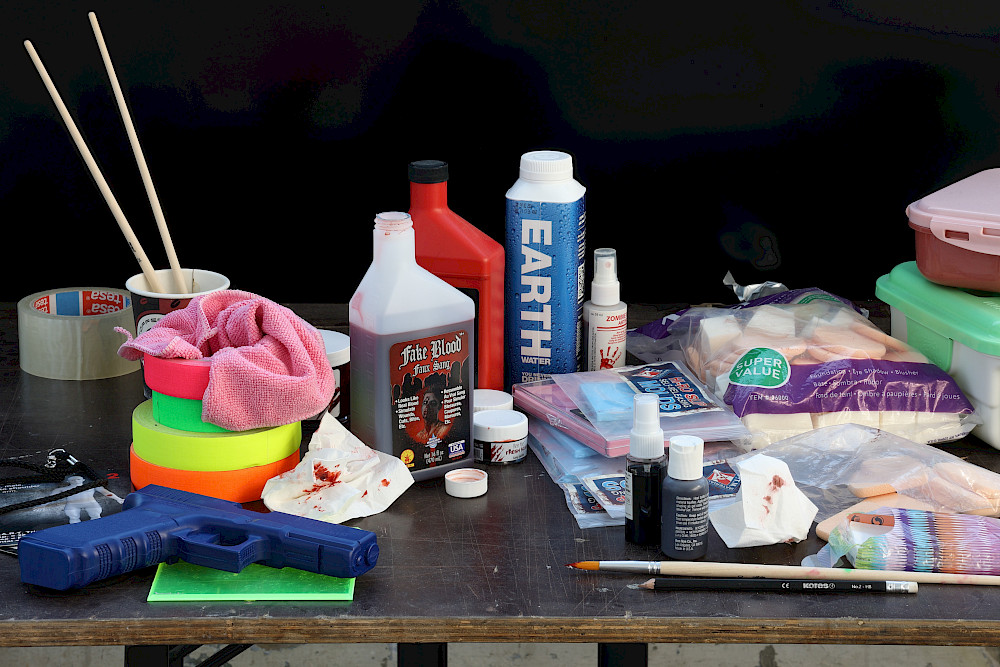
In recent years, artist Emmanuel Van der Auwera has investigated active shooter drills in the United States. Law enforcement reconstructs full-scale sets, and companies sell training programmes designed to teach people how to survive mass casualty events. Every element flirts with the codes of theatre—the “reality-based” sets and scripts, the make-up of participants playing the wounded. For years, Van der Auwera conducted interviews with drill participants, trainers, and conspiracy theorists, many of whom claim that mass shootings never happened but were staged as part of an attempt to increase gun control.
Through a skilfully minimalist composition, Can You Make a Hurricane? ventures into the construction of the conspiracist narrative, weaving real dialogues with live cinema and found footage. While playing golf, a character smirks and remarks: “In a way, we were visionary, we saw the first ripple in the water a decade before the storm.”
Van der Auwera recreates the microclimate of a world in which concepts such as reality and truth have ceased to matter. On the limit between fiction and reality, and anticipating a major exhibition at BPS22, he creates his second theatrical project: a surgical portrait of a dystopia closer than one might think, and a sharp reflection on the role of theatre in a post-truth era.
I arrive at 9AM in our dedicated event room at the Miami Hyatt Regency. The room itself tells the story: oversized, with a plush carpet decorated by abstract motifs vaguely resembling waves. In the corner, a foldable table holds our catering breakfast.
Sergeant Steve from the Palm Beach SWAT team is already there, chatting with his SWAT colleague. Steve is slim and looks like someone you wouldn’t want to cross, and yet I inexplicably enjoy being around him. His colleague is young, broad-shouldered. I spot the group of the librarians, elderly ladies led by a senior staff member. The people from the massage salon are also there, one of them in a Batman t-shirt, somehow fitting in an active shooter training course.
ALICE is an acronym that stands for Alert, Lockdown, Inform, Counter, and Evacuate. It is a program designed to enhance the chances of survival in an active shooter situation, “should you encounter this particular form of disaster,” as our instructor put it. Sergeant Doyle is a short man in his fifties, completely bald, with a tense, wiry body. His day job is New York City cop; his part-time job, ALICE instructor.
We get split into teams. I end up with Steve and a rabbi from Pennsylvania. Our scenario: a mass shooting in a place of worship. We hastily barricade the door with a belt while everyone gets into character. Steve’s SWAT muscle memory has kicked in, and he radiates a calm, dark tension. The rabbi, meanwhile, has decided he is in charge of the operation. A librarian plays the shooter and bursts through the double doors, spraying foam bullets across the room with an oversized NERF gun. I am hit, but hey, these are foam bullets. We reply by throwing red soft balls that represent scissors and staplers, or anything really, before swarming and subduing her.
During the pause that follows, I chat with the young man from the massage salon. They are here, he says, because of the Pulse nightclub. The LGBTQ community is a target of mass shooters, and they realized their salon has no back exit. They want to know what to do if it ever happens.
The seat creaks with every move. My back is numb but I hold the pose, keeping my eyes aligned with his, just a few inches above the camera lens. I watch his eyes move and shift, between hesitation and resolve, as he tries to answer my questions as best he can. We are high above downtown, and through the glass wall, you can make out the outline of Disney World’s structures in the distance, beneath which visitors walk in the sunlight and build memories of happiness.
He used to hide his face in previous interviews, an obvious safety measure for a man who has been harassed for 13 years. His apartment is immaculate, almost sterile, with little decoration. A robot vacuum sits on its charging base in the corner, a small, obedient thing in an otherwise still room. He seems always in control, of himself, of his story, of the narrative.
But as the light fades and the camera stops rolling, he opens up, offering glimpses of his inner world and the weight it carries. The whales, he says, with all their barnacles and scars and propeller marks, there is an elegance in the way they move. Sometimes he sees himself walking, and you can see him too, but there are things moving with him that remain invisible. Like an iceberg. His son was the youngest victim of the Sandy Hook school massacre in December 2012.
We settle on Pelican & Rye, a Prohibition-era themed diner on North Ocean Drive. I arrive early and wait inside, absentmindedly watching the sportscast on the screens above the counter. He arrives shortly after and seems to know the place.
“Let’s go out back. There’s a terrace where we’ll be able to talk privately,” he says.
He’s brought two books. I recognize one of them: Nobody Died at Sandy Hook. He co-wrote a chapter in it.
He jokingly suggests I try the crocodile steak. I reply something about crocodile tears. But I order the three mini cheeseburgers; he goes for the Caesar salad. The sunrays bouncing off the lagoon beside us are blinding, and I have to squint to see the man across from me, a 55-year-old with gray hair and gentle eyes.
“How old was your daughter when Sandy Hook happened?” I ask.
“Ten,” he says.
A long silence.
“You know, I still don’t understand your angle on this,” he says at last. “You think I invented this theory because people can’t cope with trauma.”
“There are people investigating you, too, you know. I asked GPT. Look: What is Emmanuel Van der Auwera’s opinion on conspiracy theories and Sandy Hook? It pulled up an article about you. Says you believe these events are so traumatic that people cope by denying they ever happened.”
Silence.
“Possibly.” I finally say.
Nothing about him seems unusual. Except that he believes the parents who lost their children that day are actors, impostors playing their roles for life.
He insists on paying. Before leaving, he turns to me.
“I hope you have found whatever you came looking for.”
He leaves, and I wait for the Uber, a billboard looming over us: an old man with his arms wrapped around a faceless robot, two black dots for eyes.
- Emmanuel Van der Auwera
Presentation: Kunstenfestivaldesarts, Les Halles de Schaerbeek
Concept and direction: Emmanuel Van der Auwera | Assistant dramaturg and editing: Pedro Gossler | Performance: Davis Freeman, Malak Atif | Make-up and performance: Dominique Binder | Make-up studio: Bloody Marys (Florence Thonet, Anne Van Nyen) | Creative consultant: Sophie Sherman | Light designer: Gregory Rivoux | AV operator: Morgan Souren | Livestream and camera operator: Julien Stroïnovsky | Production and administration: Entropie Production (Pierre-Laurent Boudet, Stephanie Bouteille, Lucille Belland)
Coproduction: Kunstenfestivaldesarts, Les Halles de Schaerbeek, CIGO (Studio Van der Auwera)
Residencies: Bodeek Brussels, Les Halles de Schaerbeek
Thanks to Harlan Levey Projects, courtesy Harlan Levey Projects and the artist