08 — 11.05, 13 — 15.05.2026
Alice Diop Seine-Saint-Denis
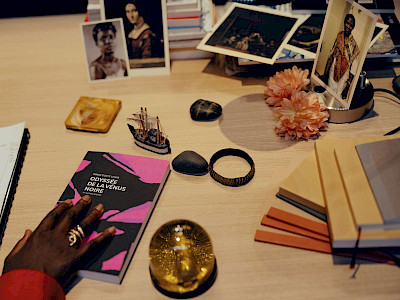
Le Voyage de la Vénus Noire
lecture performance

 | French → NL, EN | ⧖ 1h15 (+ film: 21min) | €20 / €16 |
In her dreams, the Black Venus travels through the night, visiting museums around the world. She collects body parts to gather on her ship, fragments of the Black women that Art history has buried before our eyes—sometimes anonymised, sometimes dismembered to become ornaments. Award-winning director and screenwriter Alice Diop discovered the text she had been waiting for in Robin Coste Lewis’ Voyage of the Sable Venus.
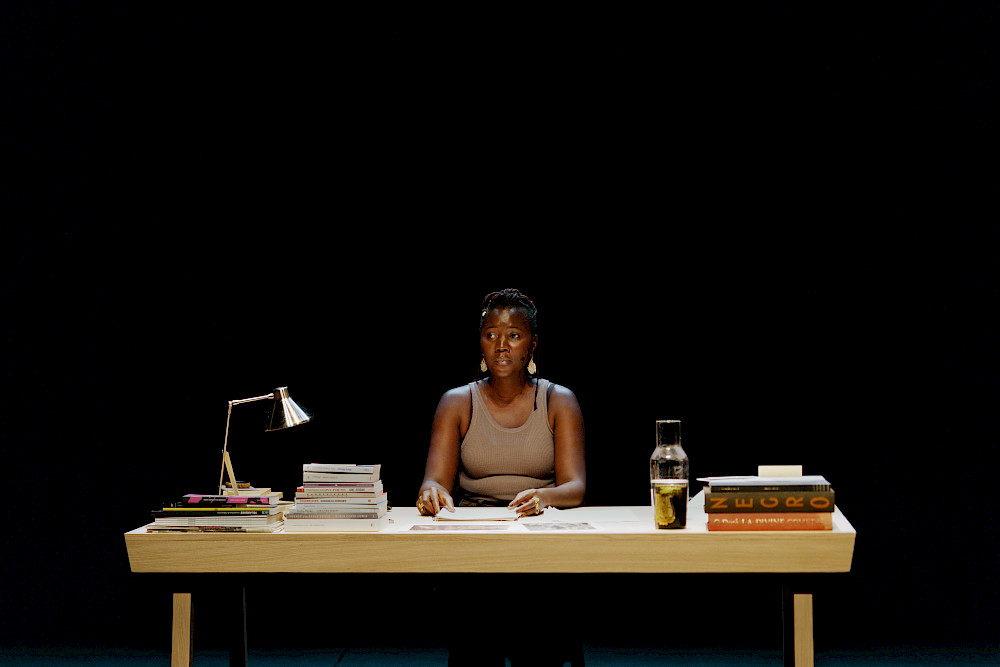
True to her cinematographic work, which gives voice to the ordinary experiences of invisible characters, she now becomes the storyteller. For her first theatrical performance, Diop gives us access to her “inner chamber”, allowing herself to be permeated by the text. Seated at her desk, she begins reading the text aloud, recounting her own ghosts as the Black Venus navigates our unconscious.
From start to finish, the journey of the Black Venus both highlights and heals the traumas of Black women. It bandages the bodies cast aside by History and invites us to think about how the violence of History has shaped our innermost selves. The audience can choose to prolong this performance by viewing Diop’s short film Fragments for Venus, thereby offering a look, both documentary and poetic, at a text of incandescent beauty.
"A hypnotic performance." Kilian Orain, 2025, Télérama
"A powerful entry into the world of theatre" Inès Boittiaux, 2025, Beaux Arts
Allowing oneself to be pierced and transformed
Marie Richeux – Robin Coste Lewis speaks of “love at first sight” with regard to the figure of Black Venus. You yourself say you were struck by the text; in your view, what accounts for this?
Alice Diop – A friend read the text to me three years ago, on a bench in Brooklyn. I was immediately struck by its power. It created a sense of awe that’s hard to put into words. It is the text I needed, the one that brings everything together—all my “selves,” articulating things that had previously been unspeakable. Its poetic, and nearly epic form distills years and years of extremely thorough academic research on the representation, objectification, and fetishisation of Black women’s bodies in art. And it’s precisely because it comes at us with this poetic breath that we can do nothing but surrender to it. To let ourselves be pierced and transformed. The text possesses an impressive intellectual maturity, and it captures me at a particular turning point in my journey;
it captures me precisely through its language. Therein lies the text’s great novelty: its power of expression. The Black Venus—she pieces the fragments back together, she gathers the debris. She is a whole figure, standing there, for herself. This figure is our mother, our sister, all those women who came before us but whom we did not look at because our gaze was tainted by violence. Today we can look at them from a fresh perspective.
There is a very political dimension to this journey, which delves into the heart of the history of representations; yet, as the text unfolds, it reveals an increasingly tender, intimate side. One senses a rebirth, an almost loving call to “start the world anew.”
Yes, it’s actually a very visceral text, because once you’ve gone on that journey with the Black Venus, once you’ve seen, experienced, and witnessed the fragmentation of Black women’s bodies throughout history and art history—and the visual unconscious on which all this rests—you can no longer pretend you haven’t seen it. From this revelation, you have to start your life afresh. It is a profound new beginning, in terms of both gaze and language; it’s a powerful impetus. It can speak to everyone, regardless of their place in the world. This text is so rich that it can be interpreted in a thousand different ways. The horizon of love it is aiming for lies beyond anger, beyond confrontation. The Black Venus’s strength is relentless because it is calm. She draws us in, and at the end, she simply says that she’s afraid to love, to be touched, to be approached. For the violence of racism, of dehumanisation, is so deep-seated and so ancient that it touches the very core of who we are. It affects how we relate to ourselves and to others. We are traumatised by what this visual unconscious has created. It breeds insecurity, violence and neurosis. This violence has infected me; it infects us all, but I had never looked at it like that before—never confronted it so deeply—in a way that I could free myself from it. At the end of this long theoretical and artistic odyssey, when Coste Lewis writes “your hand on my hand, it’s too much,” I am suddenly overwhelmed because I profoundly feel what she means. I wish I could say this to every listening ear, and be heard. Because it heals. It heals us—women, men, white people, Black people. It heals us all.
The text concludes with these lines: “Please, sit there and read for me.” In this performance, you are also the performer, which is a first for you. What is the meaning of this gesture?
I never thought I’d end up on a stage one day. In my films, I never take centre stage, I’m never in the spotlight. Yet, with this script it was impossible to imagine doing anything else. I couldn’t have approached the material any other way. I couldn’t have adapted it for the screen, superimposing images over all the images the text conjures up; this would have negated it; reduced it. I had to be able to address it directly. The words had to pass through my body as a Black woman. I had to expose myself. I do so all the more willingly because the text protects me; it allows me to appear, to move forward naked. I see it as a camera obscura, offering access to something extremely intimate, though never indecent, because the text is magnificent. I am protected by its powerful language. Full of images, full of thought, full of sensitivity. This text is a vehicle, a boat. It can carry you and pass through you.
But with the ending, “read for me,” I also want to say to those who will listen: do your bit, take it from here, do this for me, for yourselves, for us now. This long poem is a source of comfort for each and every one of us. For me, it heals me of my obsession with being heard and understood by ears that cannot or will not do so. It opens up a new horizon, one that lies beyond ideological debate. I sense that it will enable me to write new female characters—women who exist for their own sake, who will no longer be the objects of predation nor be obsessed with confrontation. I think that reciting this text also brings a certain cycle of stories to a close and allows me to begin another. It invites such a deep dive into oneself—so free, so profound; it is exhilarating, it is generous. It’s extremely liberating. I believe we must not underestimate the power of political action and emancipation that this can bring.
- Interview by Marie Richeux as partof the Festival d’Automne à Paris, April 2025
- Translated by Jodie Hruby
- Marie Richeux is a French writer and radio producer at France Culture.
Presentation: Kunstenfestivaldesarts, Le Rideau
Concept and performance: Alice Diop | Text: Robin Coste Lewis | Translation, subtitling and artistic collaboration: Nicholas Elliot | Outside eye: Thierry Thieû Niang | Lighting design: Marie-Christine Soma | Props and stage management: Lucie Basclet | Costumes: by LEMAIRE | Rehearsal director: Léa Boublil | Translation proofreading: Jean-Philippe Tessé | Lighting technician: Pascal Alidra Biron | Sound technician: Emmanuelle Loève | Set design, technical support and production: the MC93 teams
The French translation of Robin Coste Lewis' text is published by Gallimard (November 2025)
Production: MC93 - Maison de la Culture de Seine-Saint-Denis, Festival d'Automne à Paris | Coproduction: Kunstenfestivaldesarts, Le Rideau, Comédie de Genève, La Comédie de Valence - CDN Drôme-Ardèche, Wiener Festwochen - Freie Republik Wien, Centre Dramatique National Orléans - Centre-Val de Loire, MansA - Maison des Mondes Africains