08 — 11.05.2026
Apichatpong Weerasethakul Chiang Mai
A Flower of Forgetfulness
performance / expanded cinema — premiere


 | Thai → NL, FR, EN | ⧖ 1h40 | €22 / €18 | Free roaming, standing event with limited seating
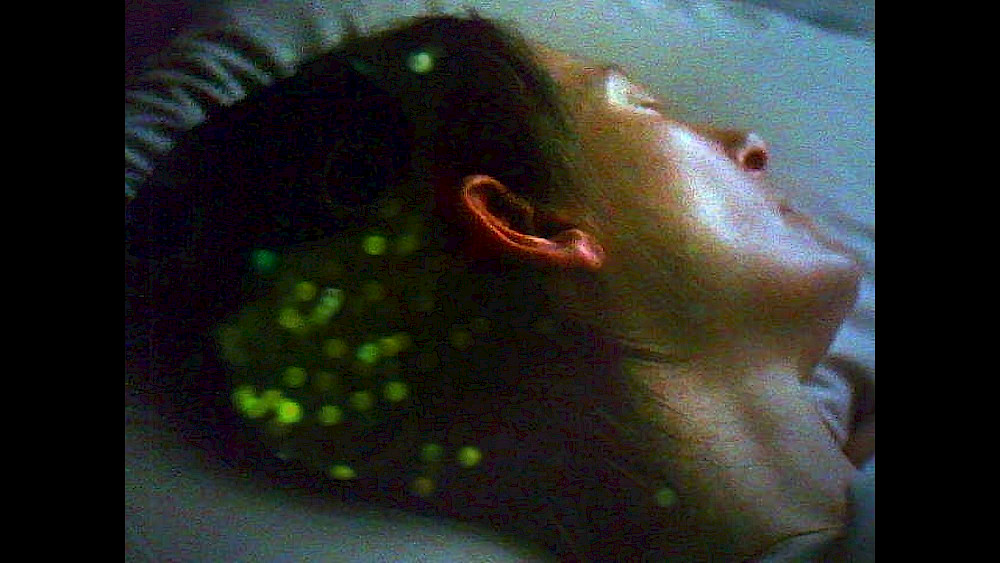
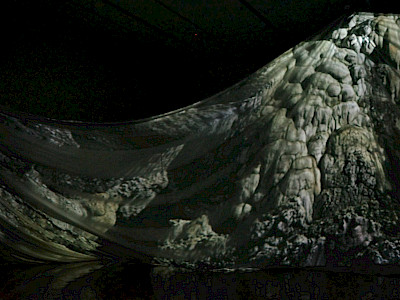
Inside the space of the Brigittines’ Chapel, a large white fabric floats in the air, as if guided by an eternal wind. Images projected on it, emerge and vanish through folds and shadows, like a collective cloud of half-remembered dreams drifting over the audience. For this new performance, commissioned by the festival and one of the edition’s most anticipated projects, filmmaker Apichatpong Weerasethakul and his artistic collaborators present images from their diaries to weave a meditation on forgetting.
The visual journey reflects on recent genocides: moments of erasure, violent flowers of forgetfulness. A metal tower allows viewers to observe the space from multiple vantage points. It is at once reminiscent of a rocket launch and of a platform for contemplating sunsets. From there, the visual landscape intersects with two other storylines. In one, visitors climb Sigiriya—an ancient rock in Sri Lanka—their footsteps echoing on metal stairs. In the other, two figures communicate across continents, hinting at the fragility of memory.
The artists unify these stories to conjure a mesmerising experience perched between cinema and performance, an unforgettable moment about the possibility of forgetting, memory, distance, and continuity.
Interview on A Flower of Forgetfulness
Katrina Nzegwu – I wished to ask you about the title of the installation. How did you arrive at A Flower of Forgetfulness? What is at stake of being forgotten, that this work speaks to?
Apichatpong Weerasethakul – With the passing of Ryuichi Sakamoto, I was struck by the influence his compositions had on my teen years, how they became my soundtrack. It also reminded me of The Pilgrim Kamanita, an old book that talks about the love between two characters that spans from the past to infinity, when there’s no more universe. At one point in the story there’s this flower of an imaginary land, that, when you smell it, it makes you forget everything. I think this kind of flower is really valuable. We need to encounter the world afresh—with no conditioning, no memory. Sakamoto’s music operates in the same way for me: he always makes me see the world afresh. This idea of seeing everything anew is especially important, at this time.
A Flower of Forgetfulness is presented in the Brigittines Chapel: built in 1663, it enters into an interesting temporal relationship with the work’s technical elements. Can you talk about how the work evolved in response to the exhibition space?
AW – I was struck by the verticality of the space, how it makes you look up. That synchronised with what I’m interested in now, the aspiration of people to go up, and go beyond oneself. To climb the mountain, to go to space…which also links to this flower, this idea of trying to go beyond memory. To escape to another dimension, let’s say.
The installation is a profound monument to collaboration—as artists, you have all worked together before. Can you talk about the importance of co-creation as a methodology across your practices?
AW – Each of us brings different sensitivities to space. Our work together is always a combination of our responses in the moment, to a space—to its architecture, and even its temperature, because it affects the volume of the smoke, the sound, the way people perceive the space. This encounter with unpredictability, together, is really precious; we bring these experiences into every work that follows.
The work features four projections, one of which is on a large swathe of white fabric suspended on thin strings, that undulates, and presides cloud-like over the audience. The pleating and folding of the fabric seems to echo the ways in which memories and dreams shift and change shape over time. Can you talk a bit more about this as a conceptual premise?
AW – Rueangrith, Pornpan and I just made an outdoor installation in Singapore [with Guo-Liang Tan], called Two Who Remember the Sea. That’s a fabric piece as well, activated partly by the wind as well as a motor. The interesting aspect is that you’re aware of the invisible, the wind, as well as your own body within the space, and the flow of movement of life around you. I would love for this piece to operate like that—for the objects to create an awareness of all the interacting elements. The audience then becomes part of creating the relationships within the space.
Rueangrith Suntisuk – I’m most interested in how the fabric will play with the audience. Sometimes its motion will mean the audience has to move, or stay away. The piece is being made live.
Your practices are connected by an interest in how phenomena such as light, sound and colour can evoke memories and inner images—how their physical and immersive forms can affect bodies and minds. Could you speak a bit more about this, in relation to the experience you would like visitors to have within the installation?
AW – With cinema, you’re confronted with a single plane. In a performance space, there’s a mixture of different experiences; there are multiple points of view. I’d like people to explore without a fixed idea of what the show should be, or should look like.
Pornpan Arayaveerasid – Normally, watching a performance, we journey in our minds. For this piece, there’s also a physical journey—you have to walk; you can travel up the scaffolding. We’re also playing with kinetic elements, light, sound…so that’s very exciting for me. To see which element each audience perceives most.
The moving image portion of the piece includes diaristic fragments documenting all of your dreams—a motif that recurs across your work, Apichatpong, alongside the idea of snippets coming together to create a unified experience. Could you speak about this invocation of the thought-world of dreaming, as a space for communion?
AW – When you witness certain performances, or you’re in the cinema, it’s a collective dream, no? Especially experimental film—it really gives you a glimpse of freedom. The audio memories, the visual memories…they flow like a river, like the breeze. This idea of presence, and looking at a memory without any attachment—that was part of having the video assembled from random little clips.
Koichi Shimizu – The music uses sounds I’ve collected the past few years from many different places, that will hopefully create a dialogue by themselves. Additionally, I featured music composed by Ryuichi Sakamoto for a previous work of Apichtapong’s, that he didn’t end up using. So [Sakamoto’s] memory and emotions are also layered within the work.
PA – This space is a collection of all of our memories. My memories used to be in my head, my experience, but when they’re presented in the work, they interact with other humans’. The sound from Koichi’s memory, the footsteps from Apichatpong’s…when these memories interact, it creates a whole new world.
The work operates in an in-between space of knowing and not-knowing, waking and dreaming, reality and illusion. In a global climate dominated by definitive binaries and reactionism, this embrace of an evolving, amorphous perspective becomes a quietly political statement. Can you talk about the role of plurality across your practices, and to what extent this figures as an act of resistance?
AW – We want to control so much. We frame life and call that a movie, we give time a schedule—we want to control everything. Not knowing is really scary, but working in this space is also liberating.
For me, it’s about the act of looking, and attention and observation. To create a space for contemplation; a non-judgemental view of the world.
KS – We’re presenting something primitive: light, wind, sound as a physical form, vibrations. When these elements come together, it might evoke images for the audience, or speak to something which is happening right now in the world—but that might not be our intention. It doesn’t mean that we don’t want to represent anything, but we expect different things to be evoked for each audience.
Akritchalerm Kalayanamitr – In the very first version of the video, there were quite a few sounds of war, and other things going on in the world. Then we decided not to use those sounds, we would rather leave it to the audience’s imagination. Somehow silence can be another form of violence…or peace, as well. We tried to experiment with that.
In the chapel, the audience is free to move around; there are platforms, which allow the work to be seen at three different vertical levels. I wanted to ask you about this invitation to shape one’s own viewing experience, and how this speaks to your wider interest in creating a post-theatrical filmic space?
AW – The audience become editors themselves. They can choose from where to see the screen; how to enter into the illusion, let’s say, of this memory. With all this, we create another kind of cinema; one that exists in the real dimension, but also in the dimension of the audience’s imagination as well.
What is key is that the work can "start" at any time. It’s more about the arrangement, or the flow of information, through time. The piece will shift and transform, like a flower that is growing.
- Interview by Katrina Nzegwu, April 2026
- Katrina Nzegwu is a London-based artist, writer and Assistant Curator, International Art, at Tate. Her work skates and interrogates the line between the political and the absurd; galvanising dark humour, and often using referential or archival material to explore personal, and collective memory and experience. Preoccupied with semi-fictional mythology, intergenerational storytelling, and embodied knowledge, Nzegwu graduated from BA Fine Art & History of Art at Goldsmiths College, and MA print at the RCA. She is one-third of the creative collective When They Meet.
Presentation: Kunstenfestivaldesarts, Les Brigittines
Artists: Apichatpong Weerasethakul, Rueangrith Suntisuk, Pornpan Arayaveerasid, Akritchalerm Kalayanamitr, Koichi Shimizu | Technical assistant: Piti Boonsom | Kinetic engineer: Laphonphat Doungploy | Producer: Kamonpan Pakpised | Video diaries: Apichatpong Weerasethakul | Additional videos: Chatchai Suban | Camera assistants: Phatsamon Kamnertsiri, Nutthaphong Niamnud | Cast: Maiyatan Techaparn, Jan Valentin Sikon, Tilda Swinton, Jenjira Widner Pongpas, Sakda Kaewbuadee, Araya Rasdjarmrearnsook | Music composed by: Ryuichi Sakamoto, Koichi Shimizu | Additional wind recordings by: Lasse Marhaug | Piano performed by: Yuni Mori | Piano recorded by: Gen Tanabe | Additional music composed by: Wuttipong Leetrakul | Vocal by: NOTEP
Production: Kick the Machine, DuckUnit | Coproduction: Kunstenfestivaldesarts, Berliner Festspiele, Tainan Arts Festival, Sharjah Art Foundation, Minato Arts Center m~m
With the support of the Ammodo Foundation and Bangkok City City
Archival footage:
*Library of Congress: films by Thomas A. Edison, Surf of Monterey (1897), Return of Lifeboat (1897), Panorama of Gorge Railroad (1900)
*Thai Film Archive: The Ghost of Takhian (1940 – Srikrung Sound Film), The Blood of a Farmer (1936 – Srikrung Sound Film), Mora (1936 – Sri Burapha Phapayon)