12.05, 13.05, 25.05, 26.05.2026
Laura Huertas Millán Brussels
Coca Orbits
lecture performance — premiere
argos centre for audiovisual arts
 | Spanish, Quechua, English, French → EN | ⧖ 1h | €10 / €7 | Wheelchair accessible, no accessible toilets | Limited capacity
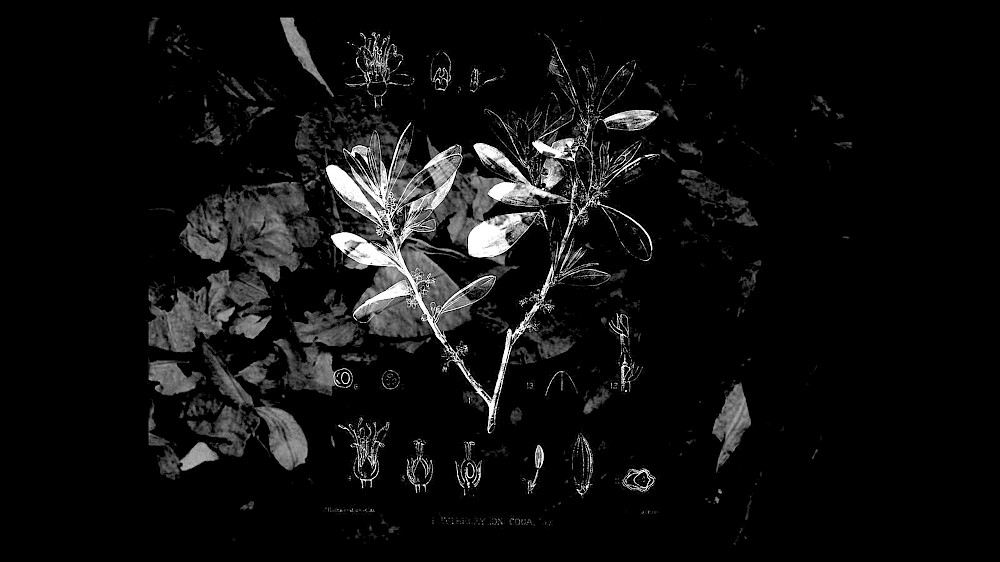
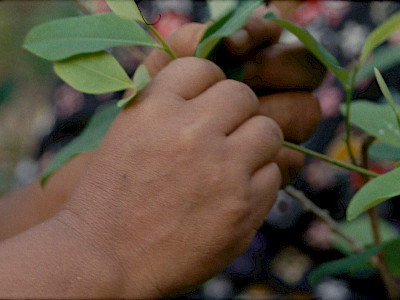
In the Western imagination, the coca plant is largely reduced to cocaine: a drug first industrialised in Europe and entangled with a violent system of extraction, prohibition, and control. But long before this history, coca held healing, ritual, and social significance for Indigenous communities in the Andes, knowledge persistently marginalised by colonial and scientific hegemony.
Since 2018, Colombian artist and filmmaker Laura Huertas Millán has engaged with this layered history. In Curanderxs—presented in an exhibition at argos—she imagined a speculative 17th-century world where femmes clandestinely distribute coca leaves to enslaved Indigenous workers under colonial rule. With this new lecture performance, Huertas Millán creates a hybrid form between live cinema, documentary and science fiction: coca appears as a travelling character, moving from the Andes into global systems of knowledge, control, and desire.
The legal status of the coca leaf is once again under debate at the United Nations, and the so-called “war on drugs” obscures deeper geopolitical and economic interests. But Coca Orbits insists that, more than an object of prohibition, coca is a lens through which we can ask the question—who produces knowledge?
Coca Orbits
Sofia Dati – Coca Orbits weaves a reflection on otherness, alienation, and extraction through the intertwined histories of the coca leaf and cinema. Why these parallel narratives?
Laura Huertas Millán – I’m conducting a long-term investigation into the coca leaf, which has been unjustly criminalised since the 17th century. A sacred plant in South America for thousands of years, it was banned by the colonisers and subsequently extracted, studied, and processed here in Europe, giving rise to cocaine. Although cocaine is primarily a Western invention and concern, the stigma of its trafficking rests on Latin America. Cinema, on the other hand, is always portrayed as a Western invention, a technology imported to the Americas.
I want to make these two narratives more ambivalent by bringing them together: what if we were to think of them as technologies of vision? Cinema would then derive from indigenous vision rituals, in the same way as psychotropic plants such as coca. Thinking of cinema in terms of appropriation and extraction is consistent with its role in the European colonial enterprise. Cameras and films played fundamental parts in dehumanising invaded peoples and imposing racial hierarchies.
So I take these two technologies (coca and cinema) as my starting point in order to understand the dynamics of extractivism inherent in their history. Coca Orbits sets this intertwined reflection in motion, with a touch of humour.
Your work takes a critical look at the genres of documentary and ethnography. Here, the realm of the strange emerges as a space for telling stories in another way. How does your use of (science-)fiction fit into this spectrum of knowledge-making, perception, and storytelling?
I do not believe in the objectivity of the documentary form. The construction of truth it proposes is rooted in categorisations inherited from colonialism, aimed at erasing non-Western knowledge. I’m more inspired by thinkers such as Saidiya Hartman and Trinh T. Minh-ha, who work with and against the idea of the document—through “critical fabulation” in the case of one, and “interval” in the case of the other. My practice sits in the in-between, between essay and fiction, between fieldwork and speculation. In this sense, science-fiction has always inspired me. It specifically critiques Western forms of knowledge by depicting radically different civilisations and the manifold consequences of their encounter. Occasionally, it can “document” more effectively, through allegory, the founding genocide of the “Americas”.
According to indigenous leaders Cristobal Gomez (Murui-Muina/Bora) and Mayor Luis Yunda (Nasa), coca is a sovereign intelligence that expresses itself through us. How can we bring this non-human intelligence to life? I took the liberty of experimenting with my own body to explore potential resonances, which unlocked several possible bodies—sometimes unexpected, sometimes offbeat: the alien, the celestial body, the King, the performer... all of whom play with the normative gaze.
The piece is structured like a collage of images drawn from various sources: a 16mm video recipe meets found footage of images produced by NASA. How do you navigate through these spaces, where the cosmos is found as much on the scale of our cup of tea as in the aerial view of a planetary landscape?
This convergence stems from the plant itself and the ancestral knowledge surrounding it. Mayor Luis Yunda, whose voiceover accompanies the images of space, describes the plant in these terms: it is a technology that allows us to travel through space and time, on scales comparable to those of quantum physics. At the macro- and micro-molecular levels. The diaspora collective Coca Worlds speaks, quite aptly, of the ‘worlds’ of coca. These dialogues led me to imagine the plant as a galaxy, bringing together an immense variety of uses and cosmologies, several celestial bodies, and several inhabitants. Perhaps the plant does not belong to our Earth, but it is our Earth that develops around it. Tea is an invitation to let oneself be infected by these collective and sensory memories.
The play begins with this tea, served by a character moving through a dark space resembling a building site or a laboratory; it concludes with a cathartic karaoke performance and live music on stage. With this dramatic arc spanning from service work to cultural production, Coca Orbits also tells the story of a transformation in the image of migrant labour.
The alien allows me to seize upon and humorously subvert a painful cliché: the migrant in the service of…, who is supposed to be invisible and literally alienated. Here we see them moving through different environments, from the cinema screen to the streets of Brussels. This journey culminates in music that carries within it a complex, diasporic memory: historically, cumbia and salsa are the result of processes of uprooting, displacement, and cultural mixing. Cumbia blends Afro and indigenous rhythms, Spanish lyrics and remnants of Christian narratives. Salsa, for its part, is a music of exile born within the Cuban, Puerto Rican, and Dominican diaspora in New York, becoming a sort of rallying cry passed down from generation to generation. Re-enacting this music on stage in Europe is deeply meaningful: it is the sharing of a powerful heritage capable of transforming our shared realities. I wanted to begin with the alien, with alienation, and finish with a creative reversal, to bring into play this shift that struck me as particularly telling.
A creative reversal that you embody so powerfully in your drag performance. Would you say that this drag king character is part of a sabotage effort towards a univocal, linear narrative? Somewhat in line with the way in which you move away from the linear by combining different registers or cinematic devices?
Yes, certainly. The piece features several symbols of constraint and authority that are reappropriated, sometimes ridiculed. It’s a form of semantic sabotage. Furthermore, I have quite an emotional and visceral connection to drag. This practice allows me to take ownership of oppressive symbols, turn them on their head, and make them into a liberating display. Telling one’s story with humour to transform alienation into exuberant and proud poetry. Through drag, I am finally at home, in my own body, and I feel able to draw others into my reality. It is a form of philosophy: one stages one’s own othering to bring to the surface what acculturation (which is, of course, heteronormative) has made us repress. Everything that is different, strange, out of place or meant to remain secret becomes the singularity that allows us to take centre stage. Drag is also a form of archive, or counter-archive, which allows stories to be told from the perspective of people placed in subordinate positions who are reclaiming control of the narrative.
- Interview by Sofia Dati, April 2026
- Translated by Jodie Hruby
- Sofia Dati is a curator at WIELS (Brussels), where she has contributed to solo and group exhibitions as well as a wide range of discursive programmes. Previously a visual and audiovisual arts programmer at Beursschouwburg (Brussels), her practice encompasses exhibitions, film programmes, collaborative curatorial projects, and publications.
Presentation: Kunstenfestivaldesarts, argos centre for audiovisual arts
A live film by Laura Huertas Millán | Concept, production, filmmaking, performance: Laura Huertas Millán | With: Mayor Luis Yunda, Julián Dupont, Laura Huertas Millán | Musicians: Danny Millan Collazos, Pavlo Cherniavskyi (Brussels Salsa Project) | Director of photography: Elsa Audevart | Light and audiovisual management: Stijn Schiffeleers | Drag consulting: Ernesto Coyote
Coproduction: Kunstenfestivaldesarts, argos centre for audiovisual arts, transmediale
Thanks to Cristobal Gomez Abel, Grégory Castéra, Daniel Blanga Gubbay, Juan Pablo García, No Más Metáforas, Universidad Autonóma Indígena Intercultural (UAIIN), Matilde Silva, Joachim Naudts, La Barakakings, Le Sourcil drag, Frederik Le Roy, Sofia Dati