09 — 11.05.2026
Germaine Kruip Brussels
A Possibility
theatre / visual arts

 | ⧖ 1h20 | €25 / €20 | Contains flashing lights and large parts in total darkness
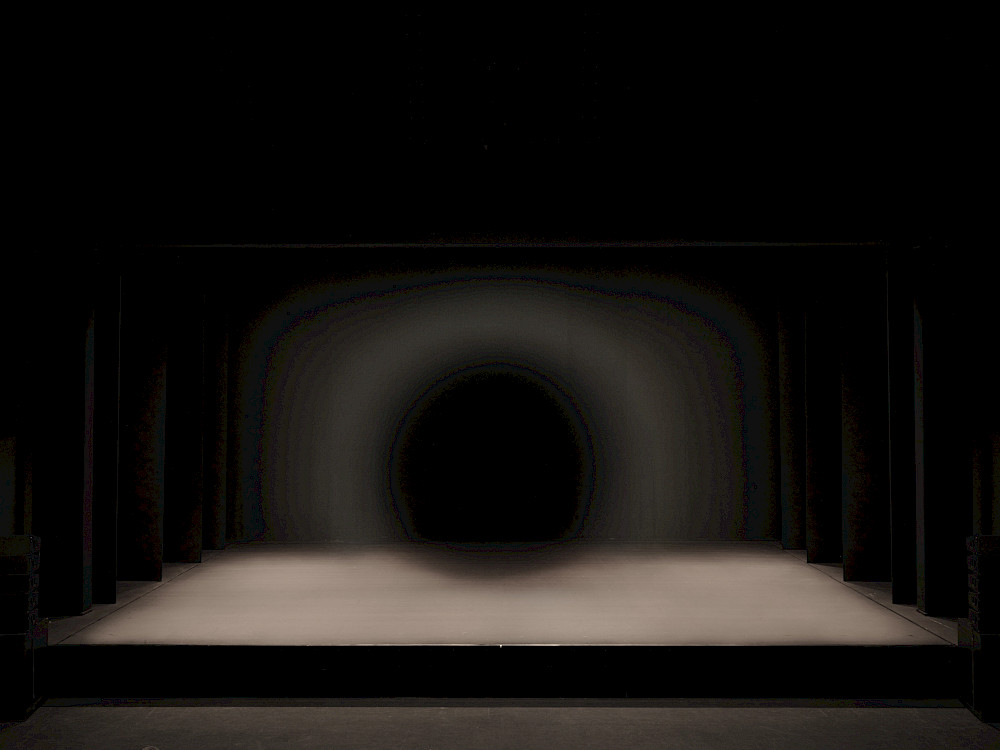
The scene is shrouded in black, white, and shades of grey. A play of perception unfolds as light interacts with shadow, reflection, and the theatre’s architecture—becoming characters in a hypnotic, mind-bending performance. With interpretation left to the audience, the work becomes a meditation on how we see, perceive, and shape our experience, both individually and collectively.
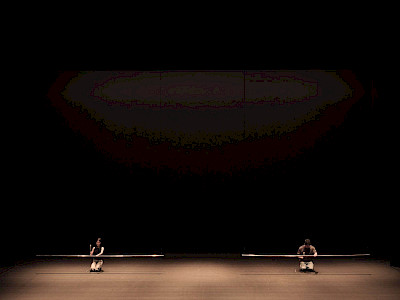
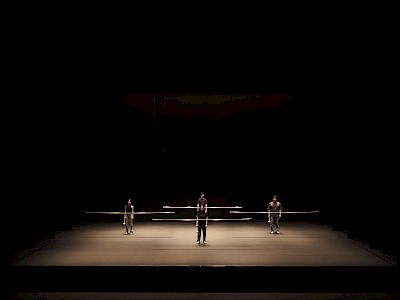
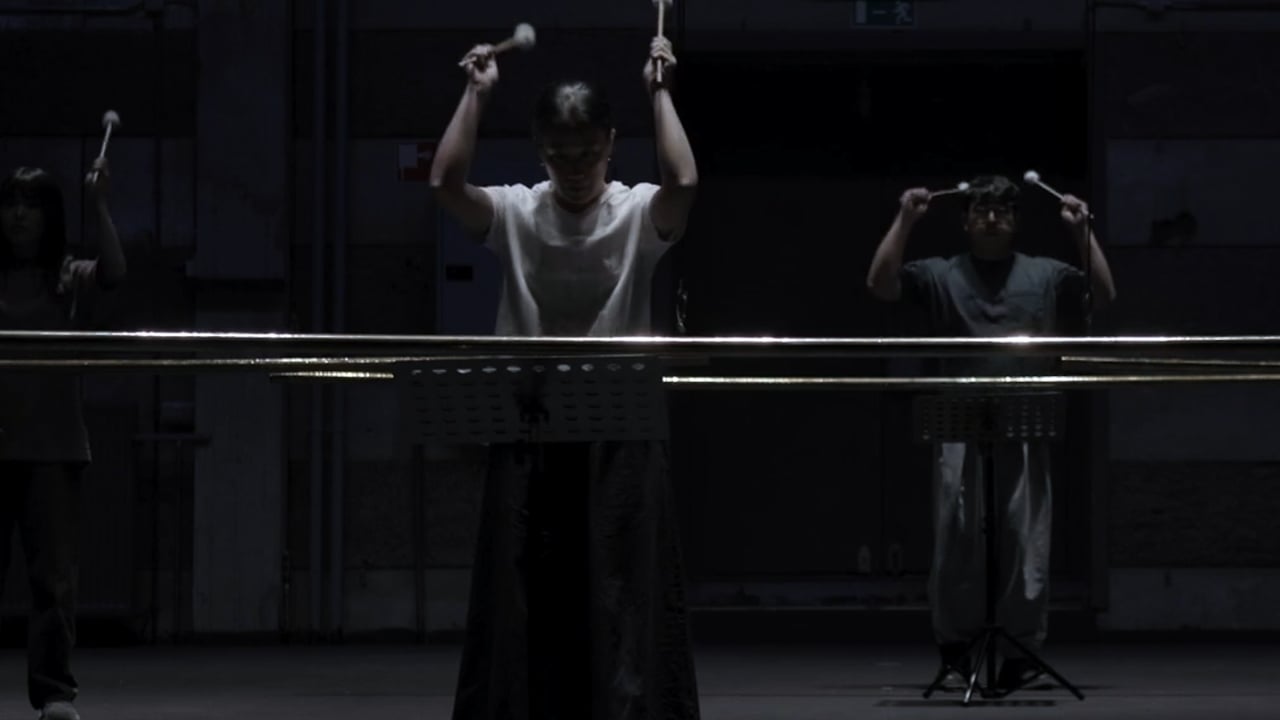
Four percussionists enter the stage, playing Kruip’s tuned sculptures through a ritual language of call and response, echo and repetition—virtuously flirting with the limits of audibility and returning us to the spiritual origins of the performance space. While each spectator embarks on a deeply personal journey, the experience is shared—an invitation to resist polarisation, to embrace multiple perspectives.
In her work, Germaine Kruip merges visual art, architecture, and music in absorbing explorations of perception, sound, and performance. Ten years after A Possibility of an Abstraction (Kunstenfestivaldesarts 2016), she presents a sequel in which the machinery of theatre becomes a musical instrument. By ritualising the theatre space as a place of wonder, she invites the audience to explore—alone and together—a world of infinite possibilities. It is a journey for the senses and a love letter to the magic of theatre.
A POSSIBILITY
There is only one interesting difference between the cinema and the theatre. The cinema flashes on to a screen images from the past. As this is what the mind does to itself all through life, the cinema seems intimately real. The theatre, on the other hand, always asserts itself in the present. This is what can make it more real than the normal stream of consciousness.
Peter Brook, The Empty Space
When I think of a thing, I’m actually thinking of another thing. One can’t think of something without thoughts of something else. For example, I see a landscape that is new to me. But it’s new to me because, in my mind, I’m comparing it to another landscape—to one I’m already familiar with.
Jean-Luc Godard, Éloge de l’Amour
Rituals bring forth a community in which resonances occur, one that is capable of accord, of a common rhythm. Without resonance we are thrown back on
to ourselves, isolated. Resonance is not an echo of
the self; the dimension of the other is inherent in it.
It means accord.
Byung-Chul Han, The Disappearance of Rituals
In his fine essay Over theatraliteit (“About theatricality”) from the collection Figuren / Essays (1995), Bart Verschaffel considers that the capturing of perspective is the essence of ‘the theatrical’: “Theatre-making is not about staging something but about determining the point from whence something must be seen. About converting a spectacle into a theatre performance that can be seen in a perfect manner. Theatre transforms the seeing as well as the spectacle. The scattered, ailing, fleeting, casual look is brought to one point, and idealised. The event, which fans out in all directions and has indistinct contours; the versatile things; the indeterminate, very sensible space, are all taken together and turned towards one point, one viewpoint.” As such, Verschaffel uncouples ‘theatricality’ from the 19th-century bourgeois definition of theatre as the art of fiction (constructed around a text) and finds a much broader definition that turns further back in time, to the Italian Renaissance and Baroque culture.
As an artist, Germaine Kruip is active in various media. She initially stepped into the art world having trained as a scenographer, building up an oeuvre of installations, architectural interventions, visual art performances, collages, mobiles, sculptures, and texts. A Possibility of an Abstraction, created in 2016 for the Kunstenfestivaldesarts, marked an important moment in her career: the return to the theatre. The performance was fuelled by Kruip’s desire to confront her experiences and vocabulary gathered through her visual art itinerary with the conventions and rituals of the theatre. What would happen to the work transposed out of its open museal home and caught in the strict threefold spatial organisation of the theatre: house, stage and wings. How would the work behave, created for an exhibition space and now framed in a meticulous theatrical temporal structure of beginning, middle and end.
When invited to do a solo exhibition at the Oude Kerk in Amsterdam in 2015, the decision to remove all artificial light was perhaps the most profound and meaningful intervention by the artist. It created a spectacular, almost never witnessed effect, especially at nightfall. The advancing, creeping shadows made time visible. The unusual absence of exhibition lighting materialised the historic monument back into stone and wood, height and depth, far and near, sharp and barely visible. The building was no longer disclosed to the viewer; the viewer was handed over to the building.
Each medium and each space have their own material logic and conventions and as such create different perspectives. Though she moves through manifold artistic contexts and is thus difficult to pin down, it is this investigative and unorthodox dialogue between the material giving of a space (spatial organisation, architecture, light…) and the expectations bound to the customary use of this space that constitutes a singular feature in the whole of Germaine Kruip’s oeuvre. Together with the material sensuality always present in the work, this ongoing conversation grounds Kruip’s strategies for the creation of art as experience.
The modernist theatre black box has banished all hierarchical organisation, along with other secular references. An evolution parallel to the one in visual art where the white cube became the referential exhibition space of the 20th century. The black box and the white cube wanted to be neutral, free of any distractions from the outside world, giving all the room to the emancipated gesture of the artist. In theatre light was one of the main constituents of this new, inverted hierarchy. The artwork on the stage became the benchmark; it’s isolated in the light and becomes the only valid, visible reality. The surrounding space (the house and the wings) disappears in darkness. In A Possibility, the light refuses this hierarchy and searchingly scans the entire architectural and cultural habitat that comprises the theatre. A Possibility is a site-specific performance.
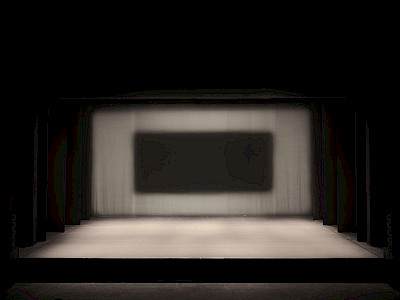
The timeless neutrality of the modernist black box was obviously a utopia. Although the theatre doors are closed and the house lights extinguished, the world cannot be shut out. Via our heads, it sneaks in. Cables and the fly rail betray technology and the peeling paint on the rear wall betrays the passing of time; the illuminated arrows that must swiftly show us the exit in case of emergency and must never be extinguished, the materiality of our bodies. The world is not only present in the theatre in the pragmatic signs and traces of the past. We, the public, import the cultural history of watching. The voices in the audience go quiet when the house lights dim. The unconscious acknowledgement that the protagonist enters from the left, and that whoever comes from the right forms a counterforce (i.e. for Western audiences that read from left to right.) An illuminated, elongated rectangle on the rear wall evokes a film projection. And so on and so forth. Thus, the degree zero of referentiality proves to be another modernist impossibility.
The 2026 performance A Possibility builds on the proposal of A Possibility of an Abstraction created in 2016, at first offering the spectator an empty space that functions as a projection screen for a contemplative and associative reflection on the act of seeing and perceiving, visibility and invisibility and the materiality of light. In a second time, A Possibility introduces a totally new element in its formation: human presence. Enter the performers. Four percussionists explore a series of brass objects created by Kruip in collaboration with the renowned German musical-instrument manufacturer Thein Brass. Forged from a unique metal alloy and shaped as beams, they function simultaneously as playable instruments and as sculptural forms. At this point, the performance becomes as much a play on hearing as it was before on seeing. Sound becomes language and movement on stage becomes ritual action.
Even more than the seductive control of the perspective offered by the stage in comparison with the scattered view in an exhibition space, the power of collectivity has lured Germaine Kruip back into theatre. With A Possibility, the artist wanted to create a shared ritual of attention.
We, the public, use our heads as a camera, our eyelids as the shutter, our pupils as the focus. We reflect on what we see and what we hear. We hear and see what we feel. Together we try to see what we see.
Bart Van den Eynde
Bart Van den Eynde is a dramaturge who works across theatre, performance, and visual arts, collaborating with major artists such as Eline Arbo, Charlotte Bouckaert, and Germaine Kruip. He has had a long-standing partnership with director Ivo van Hove since 1995 and has also been influenced by choreographer Meg Stuart, contributing as a dramaturge to several of her works.
***
A Possibility is conceived for the black box architecture of the theatre—an observation room where, during the time of a performance, the rules of reality are suspended. What captivates me as an artist is not control over the stage, but the possibility of seeing the theatre itself as a machine—one that reveals mechanisms of illusion and perception—and as a ritual site where new forms of connection can emerge.
In A Possibility, shadow and light, silence and sound slowly unfold, evolving from a visually abstract space into an acoustic environment. The audience must surrender to both light and sound—to their presence and to their absence. Only after a moment of resistance can a heightened awareness emerge.
Like much of my work, this performance leaves ample room for interpretation. It serves as a meditation on how, through perception, we shape the world—both individually and as a collective.
- Germaine Kruip
Presentation: Kunstenfestivaldesarts, KVS
Director: Germaine Kruip | Composer and musical director: Hahn Rowe | Dramaturg: Bart Van den Eynde | Lighting designer: Germaine Kruip, Rob Halliday | Assistant director: Maxime Fauconnier | Percussionists: Youjin Lee, Akane Tominaga, Victor Lodeon, Gil Hyoungkwon, Aya Suzuki | Production manager: James Thompson | Stage manager: Alama Lindenhovius | Company stage manager: Richard Herrick
A Possibility was created by Germaine Kruip in collaboration with composers Emily Howard and Hahn Rowe for Manchester International Festival 2025. The premiere at MIF25 included a new composition by Emily Howard, Rhomb in Silhouette.
Production: Factory International | Commissioned by: Factory International, Holland Festival, PLT
Made possible with financial support from the Mondriaan Fund, the Dutch public cultural funding organisation focusing on visual arts and cultural heritage | Many thanks to Panoptès Collection, Frédéric de Goldschmidt, Astrid Leyssens