14.05, 16.05, 19 — 21.05, 24.05, 25.05, 28 — 30.05.2026
Jozef Wouters, Decoratelier Brussels
The Latecomers
theatre — premiere

 | English, French, Dutch → NL, FR, EN | ⧖ +-1h35 | €18 / €15 | Free roaming, standing event with limited seating
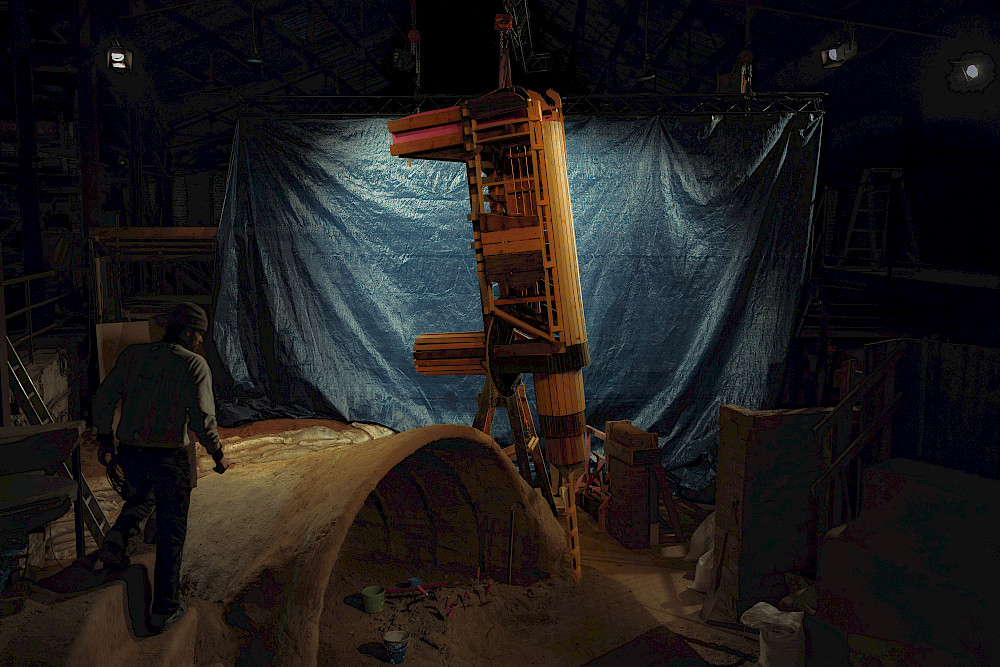
Together with the solidarity restaurant Cassonade, Decoratelier—a workshop for set builders and artists—is temporarily housed in an abandoned factory in Molenbeek, on heavily polluted land. A layer of concrete prevents oil, chemicals, and heavy metals from infiltrating the daily lives of the local residents. The municipality of Molenbeek is planning to make a park there: everything that’s being built inside Decoratelier today will disappear under a thick layer of healthy soil. Are the history and invisible stories of this place also in danger of disappearing?
Together with the caretaker, Cassonade’s chefs, local residents and visitors, the builders at Decoratelier set about the work like true archaeologists. As “latecomers”, they’re constructing a space in which to reflect on historical pollution and collective responsibility. They are unravelling the past and speculating about future ecosystems, lifeforms, and ways of living. Through structures and stories, they seek a way to share their concerns and desires with future generations. Can a society be built on top of its own mistakes? The Latecomers is a site-specific performance in which a community searches for the meaning of a place, inviting the audience to explore this strange landscape of stories.
WE ARE ALL LATECOMERS
We are all latecomers. To be human means to come after those who came before. Just as we are always preceded by our forebears, so too the ground in which we lay them to rest has always already received the bones of others—including that of other species, many of whom have died on our behalf.
– Robert Pogue Harrison
What do we want to convey to the audience in advance? Some six weeks before the premiere of The Latecomers, Jozef Wouters and I discussed this during one of our drama-
turgical meetings. Actually, it’s too early to answer that question, because we are still very much in the process of finding the form the production will take. That’s inherent to making theatre, but it also goes to the heart of what Decoratelier stands for: building out loud. Thinking aloud together as we build. We create spaces in which we can collectively search for the meanings, forms, and stories that support contemporary coexistence in all its heterogeneity—including the uncertainty and confusion that come with it. This text outlines some of the principles that have guided the process of The Latecomers over the past year.
Since the summer of 2024, Decoratelier has been occupying a former factory building in Kortrijkstraat in Molenbeek, which it is permitted to do for a period of five years, sharing the building with the solidarity restaurant Cassonade. “They were our neighbours in Manchesterstraat too; we used to go there for lunch every day,” says Jozef Wouters. “When it turned out that the restaurant also had to move, I was keen to bring them along to the new site. Cassonade has a unique approach and a collective organisational structure; they make things possible that you don’t find anywhere else in Brussels. What’s more, the interior of the restaurant was an abandoned film set, which in the Netflix series Grond served as a funeral home. People who came to eat at Cassonade mistook the interior for the real thing, even though it was just a set. This fascinates me immensely: a set in which real life takes root. It struck me that the daily practice of organising, cooking, and eating there could not exist without a fictional framework; they mutually support each other.”
“Cassonade was already a work of fiction, and the move made it even more so. The layout was mirrored in the new place; the load-bearing columns suddenly proved useless, and the windows and exterior canopy no longer had to keep the rain out. This called for further scenographic interpretation. With each variation, everything became even more of a film set than it already was. For me, that drawing-in and reinforcing of a spatial fiction has been one of the starting points of the project.”
In the current Cassonade, the setting lends a theatrical air to everything that happens there. Take, for example, the neighbourhood meeting in which local council officials came to speak about the future park that’s to be built on the site. “A large part of our studio lies two metres below ground level and will be covered with a thick layer of earth within a few years. That realisation stayed with me: everything we are building here now will be underground in the future. Actually, it’s the ideal place for our structures. That’s where stories belong. Or where stories can emerge. Right beneath our feet, yet largely inaccessible. The underground has always been a place of fiction and speculation, in mythology as well. This was a second starting point for The Latecomers.”
The site is heavily contaminated by the activities of the galvanising factory that operated here for decades. Rather than remediating the soil, the municipality of Molenbeek plans to cover it with clean soil. “That massive relocation of earth struck me as somewhat absurd. Doesn’t it deny the history of the place? This is such a typical story of rapid urban development: the future is greener and more beautiful, and we’re actually already there. We’ll soon be able to go for a walk there. How can you counter that narrative with a slower process? That, for me, is the aim of The Latecomers.”
An attempt to produce compost on a large scale using kitchen waste from Cassonade proved to be a dead end. We therefore had several lorries deliver clay-like loam soil from the Pajottenland. In an empty factory hall, we set to work with that pile of earth. With the builders from Decor-
atelier, together with the chefs from Cassonade, the two caretakers, and a few local residents, we began to make the soil our own—by sculpting and kneading it into objects and clay bricks to build with; by sifting it and inventing the story behind a stray pottery shard.
“We asked all the participants a few questions: What do you want to relinquish, bury, or add to the ground here? With what do you want to recharge the earth? Which stories should we not forget? What message do you want to pass on to future generations? We imagined archaeologists of the future unearthing our traces.”
In Decoratelier’s scenographic practice, interpreting a site is always the first step. “From that perspective, we are now dealing with an almost unreadable space,” says Wouters. “Reading a concrete slab, pollution, or the ground itself is no simple matter, not even for scientists. We learned from archaeologists why there is so little knowledge of the urban subsoil and so little historical awareness. Most soil maps date from the 1950s. Back then, the value of soil for agriculture was paramount. Urban soil remains a blind spot on those maps to this day.”
How can we work towards reconnecting with what came before us? “Fortunately, you can also interpret the subsoil by inventing stories. We found a motto in the work of cultural philosopher Robert Pogue Harrison: “On earth, we are all latecomers.” He writes about surface markers that lead to the history and stories buried in the soil. A society is shaped by the memories and narratives of what might lie beneath the ground. A kind of cultural humus. From that perspective, the haphazard introduction of new soil is actually a rash, brazen move.”
Moreover, due to urbanisation and migration, in a city like Brussels we have for several decades now seen a popu-lation living in a place other than where their ancestors are buried. Historically speaking, this is a new situation for which we are ill-prepared. The Latecomers is an attempt to recognise the urban landscape as a meaningful place, and to reach towards the future. We have very little time before the council’s bulldozers arrive—in that sense, what we are doing resembles what archaeologists call an “emergency excavation”.
“We are filling the earth with the stories and specific proposals of a limited group of people. That’s a modest gesture, but we’re also concerned with other forms of attention: with details, with neighbourhood stories, with things we find by chance. The story and how we tell it collectively must constantly adapt to all of that input. Our process is comparable to an archaeological excavation. It’s a very slow process of searching for a story based on what is unearthed, year after year, season after season. So we keep telling and retelling. We are digging towards the future without knowing exactly where we will end up.”
- Jeroen Peeters, 3 April 2026
- Translated by Jodie Hruby
Jeroen Peeters is an essayist, dramaturg, and performer based in Brussels. He has published extensively on contemporary dance and performance, as well as on themes such as spectatorship, ecologies of attention, readership, dramaturgy, embodied knowledge, material literacy, and sustainable development. Peeters is in-house dramaturg at Decoratelier.
Presentation: Kunstenfestivaldesarts, Kaaitheater, Decoratelier
Artistic direction: Jozef Wouters | Dramaturgy: Jeroen Peeters | Technical coordination: Menno Vandevelde | Created with and built by Decoratelier: Jeff Verschueren, Barry Ahmad Talib, Zoher Boumelha, khalda el jack, Fairuz Ghammam, Alice Deleu, Pauline Arnould, Michiel Soete, Chloé Tempelhof, Joran De Roover, Mona Bonnevalle, Vic Van den Bossche | In collaboration with Cassonade: Naila, Mariam, Lina, Fatima Zahra, Rasmina, Aïcha, Fatiha, Naziha, Ibrahima, Mohamed, Mehdi, Luay | Sound design: Anne van de Star | Video: Fairuz Ghammam, Sander Tas | Costumes: Sofie Durnez, Lila John | Light design: Michiel Soete | Technical crew: Remco Wuyts, Jamy Hollebeke, Ruben Wolfs/Thibault Rottiers | Stand-in: Vincent Focquet, Marie Umuhoza | Outside eye: Sodja Lotker
Production: Damaged Goods | Coproduction: Kunstenfestivaldesarts, Kaaitheater, Perpodium
With the support of the Flemish Community, the Flemish Community Commission and the Tax Shelter of the Belgian Federal Government via BNPPFFF | Many thanks to Kunstencentrum VIERNULVIER, the Summer birds, coreatelier