23 — 26.05.2026
Louis Vanhaverbeke Ghent
Tractor Rapsodie
performance — premiere
 | Dutch → FR, EN | ⧖ ±1h | €16 / €13
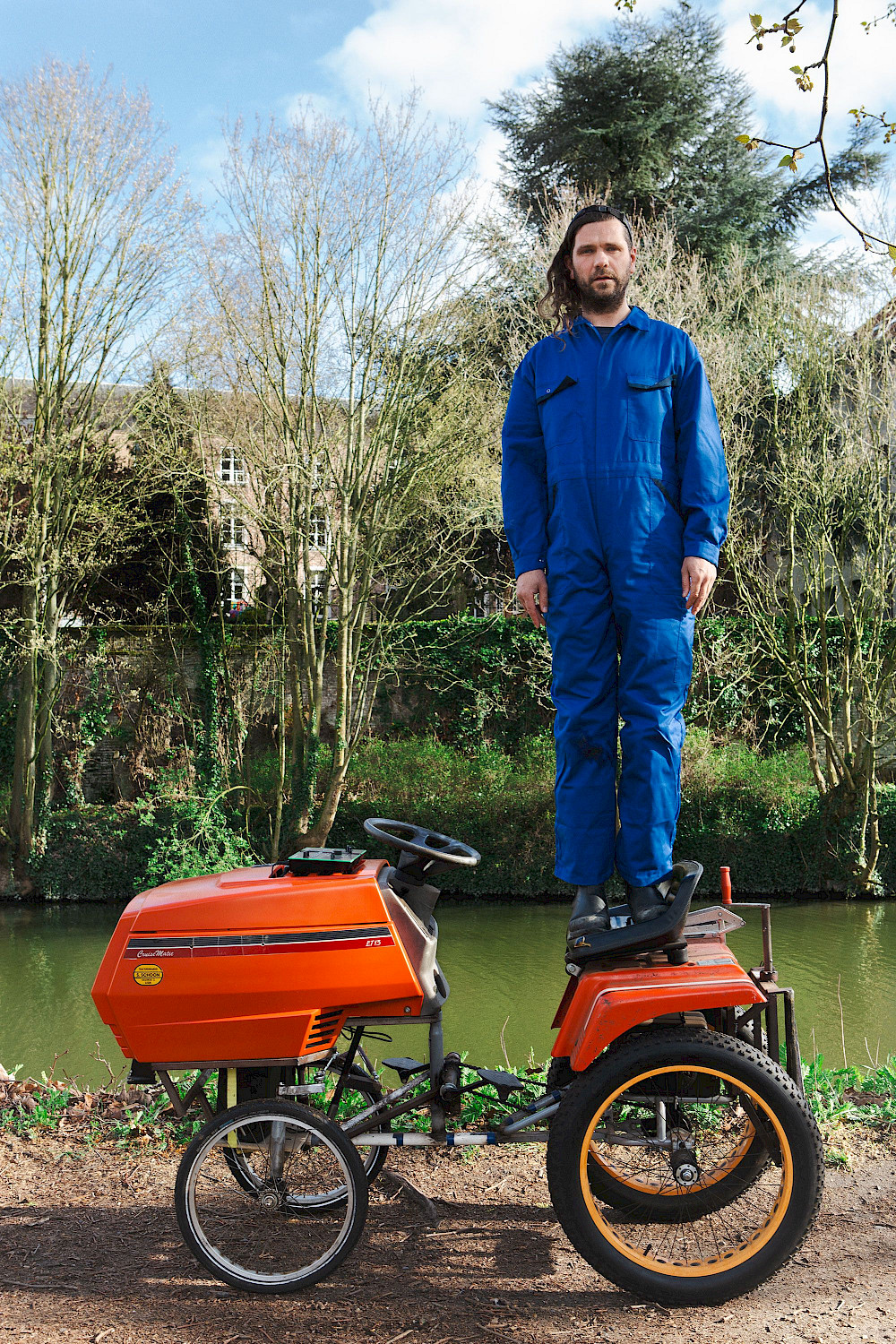
On the land of apprentice farmer Louis Vanhaverbeke, the line between agriculture and performance blurs. In Tractor Rapsodie, the artist explores his own return to the soil after a period of mental upheaval, seeking an anchor in physical labour and the cycles of the ground. Sowing, harvesting, composting: gestures that give time a tangible dimension once again.
Through songs, actions, and machinery, a vulnerable self-portrait unfolds. Alone on stage, Vanhaverbeke reveals the fragile balance between the mind and the deep earth, between the pressure to conform and the stubborn determination to deviate. What begins as an attempt to put down roots again evolves into a reflection on labour, resilience, and the desire to follow one's own rhythm. On stage, agricultural machines become true performance partners: their roar, weight, and movement dictate the pace and shatter the romanticized image of the countryside.
Tractor Rapsodie is a raw ode to slowness, where grounding is no airy concept but asserts itself as a vital, physical process. In a perpetual cycle of loss and renewal, this performance invites the audience to attune themselves with the tempo of the earth, where history, labour, and life continuously intertwine.
Interview with Louis Vanhaverbeke
Your last production at Kunstenfestivaldesarts, Mikado Remix, premiered in 2018. After that, you disappeared from the scene for a while. What happened in the meantime?
After Mikado Remix, I went through a very difficult period. We were about to embark on a major tour with the show, but I had to cancel it. That wasn’t an easy decision; rather, it was a necessary halt, because I simply couldn’t carry on. I experienced several bouts of mental turmoil, including multiple admissions to psychiatric care. It took years to restore a sense of balance, to feel solid ground beneath my feet.
The pandemic didn’t exactly help that process. On the contrary: for someone like me, who is quite sensitive to stimuli and moods, that stretch of time was more unsettling than calming. What was a break for some to me felt like an extension of an already long and sometimes lonely quest. It was a sort of odyssey, with detours, setbacks, and small breakthroughs, but above all: a slow, laborious search for something to hold on to.
How did you end up going into farming?
It actually developed quite organically. During that period, I spent a lot of time wandering around in Nature. I noticed that green spaces offered a kind of sanctuary, a place where I could simply be, without feeling the immediate need to do anything. There, among the plants and the changing seasons, I felt less pressure and had more breathing space.
Through those wanderings, I ended up at a biodynamic farm. What struck me right away was how you can be active in an environment that doesn’t work against you but moves with you. The idea that you can interact with the earth in a caring, almost reciprocal way, touched me profoundly.
I began to delve deeper and deeper into it. First, through a course in herbalism; later, in biodynamic agriculture. At one point, I even considered a complete career change. I had an enormous need for something concrete, something tangible: a way to work with my hands, where time is not abstract but palpable in what grows, slows down, fails, and restarts.
I really became hooked on the whole process: sowing, tending, waiting. And on the idea that farming is also a form of attention, a way of being present.
How did you find your way back to the arts from there?
Actually, that path presented itself to me once again without me consciously seeking it out. While working in the fields—the work often being repetitive, sometimes hard, but also rhythmic and meditative—I noticed that something was beginning to shift. In that repetition, through that contact with the soil, images, thoughts, and melodies suddenly began to re-emerge.
There were moments of pure wonder: something sprouting, something that grows without you being able to force it. Those natural processes rekindled my imagination. It was as if creativity hadn’t gone away but was lying in wait somewhere beneath the surface.
When working, songs came to me spontaneously. Snippets of lyrics, rhythms that linked to the movement of the body, the tempo of the work. That was not a conscious return to art, instead it was something imposing itself once more.
I sometimes say: I’m not a good farmer, and perhaps I’m not a good artist either. But I am someone who gets carried away by fascination and admiration. Someone who tries to follow where the energy flows. And at a certain point, that began to lead towards the stage.
Tractor Rapsodie is the result of this: a place where those two worlds do not exclude one another, they merge into one another. Where the head and the ground cautiously try to find one another again.
- Interview conducted by Dries Douibi, April 2026
- Translated by Jodie Hruby
**
Life cycles
From fertilisation to flowering,
birth and the course of life,
experiencing it all,
and in the end, death.
Starting all over again, one more cycle.
Time – tick-tock – rolls on.
Birth in the spring, of Nature.
Growth and blossom, rising temperatures.
Autumn, the decline, the falling of the leaves.
Surrendering to winter, my lowest point, a black hole.
**
Grounding
They say: “Breathe through it,
let your thoughts drift away like clouds.
Focus on your breathing and don’t let your brain spin.
Let it flow downwards, follow the sensations all the way to the ground.
Let your feet take root until you become one with the earth.”
**
Common sense
Going along with the crowd…
Apparently that’s how it has to be.
I feel better on the fringes, out in the countryside, anyway.
**
Isolation
The farmer or the artist?
Two figures, two symbols.
Precisely! They are illustrations of fighting against windmills.
As a farmer, I grow food, the very foundation of our existence.
As an artist, I peddle hot air; there’s nothing concrete about it.
**
If value is defenceless, then why not regard the arts and agriculture as my paean?
May I continue to work in acres and hours, so that the desire to create will continue to guide me.
The farmer, he carried on ploughing, his field, his soul, his work.
I learned a great deal from this craft; it made me strong again..
But strength must not be blunt; it’s better to be gentle, as they say.
That is why I am trying to bring all this together here.
Potatoes
Chemicals in the field, chemicals in my head.
Yeah yeah yeah, the speed is relentless.
Medication, pesticides, with this refrain:
“Production logic must be efficient.”
Anyone who wants to exist outside that logic is told “Just adapt.”
Pssshht, spray, on my land every little plant must be the same.
An ecosystem deserves more than the exact same treatment over and over.
Wipe out what doesn’t fit in the row, monoculture for the field and for me.
If I don’t grow things my own way, forced into this straitjacket here,
I say: “Forget it, I choose variety, not a singular potato-identity.”
What we swallow for our minds, what we spray on the field: unheard of!
Collective poisoning, silent death.
While the market offered us efficiency.
Spray the field flat, not a blade of grass protests.
Numb the mind, not a thought rebels.
Whatever grows outside the row, administer poison or pills, until field and man are willing to obey.
- Excerpts from the libretto of Tractor Rapsodie
- Translated by Jodie Hruby
Presentation: Kunstenfestivaldesarts, De Kriekelaar
Written and performed by: Louis Vanhaverbeke | Set design and machinery: Simon Van Den Abeele | Dramaturgy: Dries Douibi | Technical direction: Freek Willems | Technical support: Bart Huybrechts I Voice coaching: Miriam Matthys I Production and technical supervision: Eva Bracke | With thanks to: Bauke Lievens, Merel Van De Gehuchte, Lars Schmidt, Maarten Van Ingelgem
Production: LOD Muziektheater
With the support of CAMPO, VIERNULVIER, Rif, weder | With the financial support of the Flemish Government