25 — 27.05.2026
Angélica Liddell Madrid
Seppuku. El funeral de Mishima o el placer de morir
theatre

 | Spanish, Japanese → NL, FR, EN | ⧖ 2h | €28 / €22 | Contains nudity, live blood sampling, references to suicide, 18+
In 1966, Japanese writer Yukio Mishima released a filmed representation of his ritual suicide, or seppuku. That same year, Angélica Liddell was in her mother’s womb. This coincidence has increasingly fuelled her fascination with the author’s writings and his life outside established social norms.
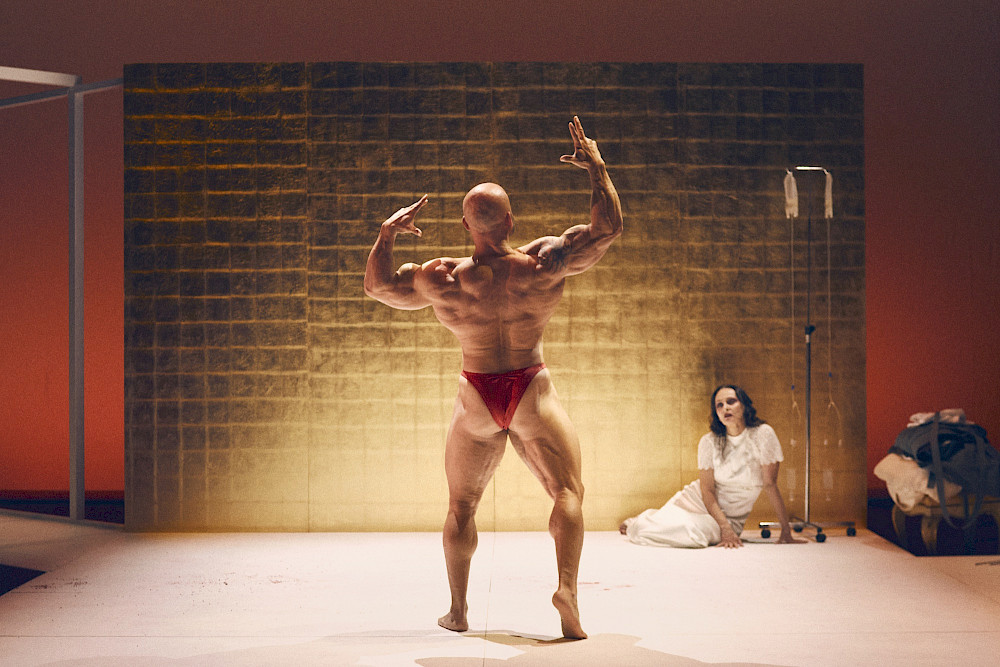
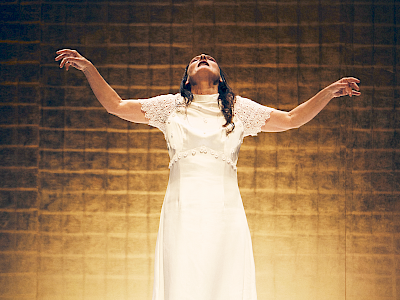
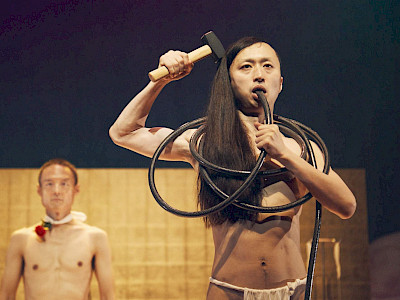
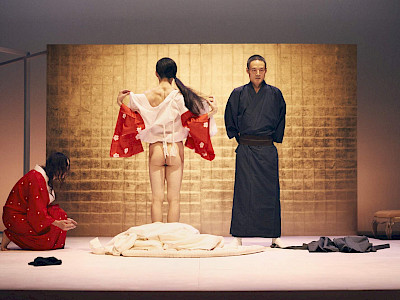
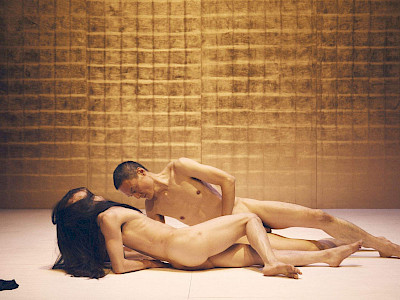
For her new creation, Liddell begins here, exploring an attraction to her own death, and the way suicide is perceived. Developed with actors from the National Noh Theatre in Tokyo, Seppuku. El funeral de Mishima unfolds as a theatrical experience. With her abrasive language and unique stage presence—merging her story, an adaptation of the 14th-century play Hagoromo, songs, and real blood-taking performed by nurses—Liddell overturns the very idea of suicide. She evokes not just the end of life, but what we face with every dawn, urged by a hyper-productive society to let our unruly inner force wither. A daily act of controlled bleeding in the service of efficiency.
In her first appearance at the festival, Liddell creates a hymn to the untameable side of life, presented at the end of the day or in the early morning: the hour of Mishima’s death, before the business of each day begins, still charged with the idle poetry of the night.
"The show transforms suicide into a poetic ritual, between mystical fervor and intimate vertigo." Olivier Frégaville-Gratian d’Amore, 2026, Coups d'oeil
Alphabetical interview with Angélica Liddell
S for Sex [or Suicide]
“Sex is a splendid tomb”, said Mishima. Sex and death alone confront us with the limits of the body. It’s the only way of knowing we’re alive in the midst of the everyday tedium.
E for Elegy [or Energy]
I call on energy at the end of life. An elegy is a poem of lamentation, and in this work, I am calling on the end of life; I claim suicide as being among the fine arts. This work is therefore anti-elegiac. I want to complete the work of art with the end of life.
P for Performance
I am very uncomfortable with this term, insofar as my “representation” is intimately linked to inner sincerity, to inner need, to the idea of death, just as Mishima represents his own suicide, over and over again. I do not work from the idea of “performance”, but from that of “representation” as desire. Representation as a deep, abyssal desire.
P for Poetry
One of the things that strikes me most in ritual suicide, is the composition of the farewell poem in the moments before the death, the “Jisei no ku” (transl.: Farewell poems of the Shell). I am not talking about a simple suicide note, but of a desire to give expression in the most transcendent way possible, that is, the ratification of a mystic state through speech, the need for beauty to exist, in order to leave the floating world and enter the real world, the world of the dead. Poetry is in itself the desire for transcendence, the need for God.
U for Utopia
Utopians reflect on the realisation of utopia, in a way they are materialists. I consider myself rather as an idealist, an ultra-transcendent. The real world does not interest me, for me what matters are the shadows thrown by the fire in the cave, the pure ideas, the non-existent. The beauty of shadows is precisely what makes us detest reality, that is what feeds our dissatisfaction, the feeling that we are not in our place in this world. Utopias do not really interest me, they end up falling into the realm of possibility, and I detest possibility. What counts is pure sensibility, in oneself and for oneself, with no link to utility. In short, I do not fight to fit in. I live disintegrated. I live in the world of angels. I live in anger against the real world, like the angels do. In the end, I am an inveterate romantic.
K for Kishikaisei [“resurrection, successfully restoring a situation of normality after the destruction or collapse of something, or of a hopeless situation”]
Without destruction, without sins, without cataclysm; there is no resurrection. We need to sin, we need to self-destruct in order to resuscitate, it is a conscious self-destruction. Those who commit most crimes will enjoy a much greater absolution, will receive more love. It is true that, in Christianity, this has miraculous connotations,
but nevertheless, destruction is necessary. It is the very essence of art: cruelty to restore clarity, immolation in order to enter Paradise.
U for Ulcer [or Universal; or Universal Ulcer]
When I was 12 years old, I already had a bleeding ulcer of the duodenum, which stayed with me throughout my adolescence. I suppose that I had somatised the ulcer, from a universe that I detested with all my strength. The human being is frightening, it is a walking ulcer.
*
E …
L for Liddell... What meaning do you give to proper names?
When I fell in love, the name filled the whole space. It is incredible how a name can encapsulate the essence of a love story. The name is the beloved in person. Just saying the name is enough. However, when I hate someone, they immediately become unnameable, I cannot even see their name written down, or hear it, their name repels me, disgusts me, I dirty myself just by saying it. The power of naming is impressive. In fact, God creates the world and names it, he names every living being that inhabits it. Even a table, even rice, must have a name. The name contains the spirit, in a more significant and more powerful way than the face or the shape.
*
F for Fight and die. Should we always take the risk of getting hurt?
In the samurai code of bushido, reflected in the Hagakure, there is a concept called “Kirinji”. Kirinji means to die with a sword in one’s hand. To die fighting. Choose death, when the choice is between life and death, knowing that the fight is doomed to fail. Without failure, there is no Kirinji. Kirinji means the total absence of any chance of winning a battle. Kirinji means fighting, while knowing that you are going to lose. You must not protect yourself, or hide under the eaves. Risk-taking is always necessary. I try to be a good samurai.
U …
N …
E …
R …
A for Act of poetry. Do you feel as though you are prolonging Mishima’s poetic gesture, or re-enacting it?
I am Reiko, the woman in the story titled Yukoku. I am faithful to my lord, I follow him in his suicide, I commit junshi, like a samurai, I owe it to him. I owe everything to Mishima, I must accompany him in death. I am going to look for his ashes in Tokyo. I have obtained one of the permissions granted to visit the place where he committed seppuku. Bergman said that if you go to the place where someone committed suicide, you can know when you yourself are going to die. You just have to ask. I want to ask this question in the room where Mishima, my love, cut open his stomach.
L …
*
D …
E …
*
M …
I for Innate or Inevitable… What can it mean today to “face certain death”, as Mishima describes it, inspired by the samurai code?
Like Mishima, I too am anguished and obsessed by the dialectic between art and life. Writing is not living. I don’t think there is room in the modern world for the samurai ethics, mainly because we do not believe in the existence of something greater than ourselves, and we have lost the ability to serve. We live obsessed with our rights, without attending to our obligations, in a spiral of disproportionate egocentrism. One must devote one’s life to something greater, in order to confirm our insignificance and eliminate our vanity. Nothing gives a samurai greater pleasure than to obey.
In our age, where we are more manipulated and controlled than ever, in a dictatorship without a dictator, we have paradoxically lost the fine sense of obedience and loyalty, and even those who believe themselves to be free are not free. This is truly the pain that brings us closer to death. We are exiles on the earth. For my part, I imagine every morning that I am dead, I have done so for a long time. I consider everything from the perspective of my death, and therein lies the heart of the Hagakure.
S …
H …
I …
M …
A for Amour. Is your production Seppuku. El funeral de Mishima ultimately a “love song”? How do you match your inner world with the external world of the performance? And if it is a song, is it dangerous?
Mishima defended secret love. Dying without revealing the name of the beloved. In his commentary on the Hagakure, he mentioned these lines from the poet Saygo, where, he said, the word hagakure, meaning “in the shadow of the leaves”, appeared for the first time.
Hagakure ni Chiri to
A solitary flower that remains
domareru Hana nomi zo
hidden among the leaves,
Shinobishi hito ni Au
such is my encounter with
kokochisuru
the one I love in secret.
Such is the essence of love for Mishima, and the essence of energy. Of course, this work is not born solely from my love for Mishima and his books, it also comes from my relationship with suicide, from my respect for those who have committed suicide. But the important thing is to construct the poem. Dying is not dangerous.
- Excerpts from an interview conducted by Najate Zouggari from TnS (Strasbourg National Theatre)in July 2025
- Translated by Joanna Waller
Presentation: Kunstenfestivaldesarts, KVS
Direction, text, set design and costumes: Angélica Liddell | Performers: Alberto Alonso Martínez, Nonoka Kato, Angélica Liddell, Masanori Kikuzawa, Ichiro Sugae, Gumersindo Puche, Kazan Tachimoto | Local extras: Esteban Delsaut, Juan Mora, Alexandre Moxhet, Louis Champy, Sarah Lagneaux, Kaoutare Bannouni | Lighting design: Javier Alegría | Technical director: Maxi Gilbert | Lighting operator: Francisco Jesús Galán | Sound: Antonio Navarro | Stage machinist: Fernando Díaz | Stage manager: Elena Galindo | Set construction: Alfonso Reverón Díaz | Logistics: Micaela Ferrer | Production: Gumersindo Puche | Assistant producer: Jaime del Fresno
Includes excerpts from the texts Patriotism and The Sailor Who Fell from Grace with the Sea by Yukio Mishima. Adaptation of the Noh theatre play Hagoromo (“The Feather Mantle”).
Coproduction: Festival Temporada Alta, Théâtre national de Strasbourg, Wiener Festwochen - Freie Republik Wien, Festival Grec, Odéon - Théâtre de l’Europe
With the support of the Community of Madrid | Special thanks to the Cervantes Institute in Tokyo and the Noh theatre actor of the Konparu school, Tsuano Yamai
Performances in Brussels with the support of the Spanish Embassy in Belgium