24 — 29.05.2026
Basel Abbas & Ruanne Abou‑Rahme Palestine-New York
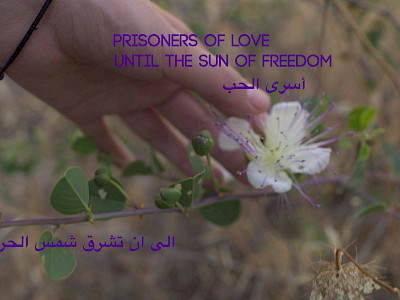
Prisoners of Love: Until the Sun of Freedom
performance / expanded cinema — premiere

 | Arabic, English (a translation in FR and NL will be provided)
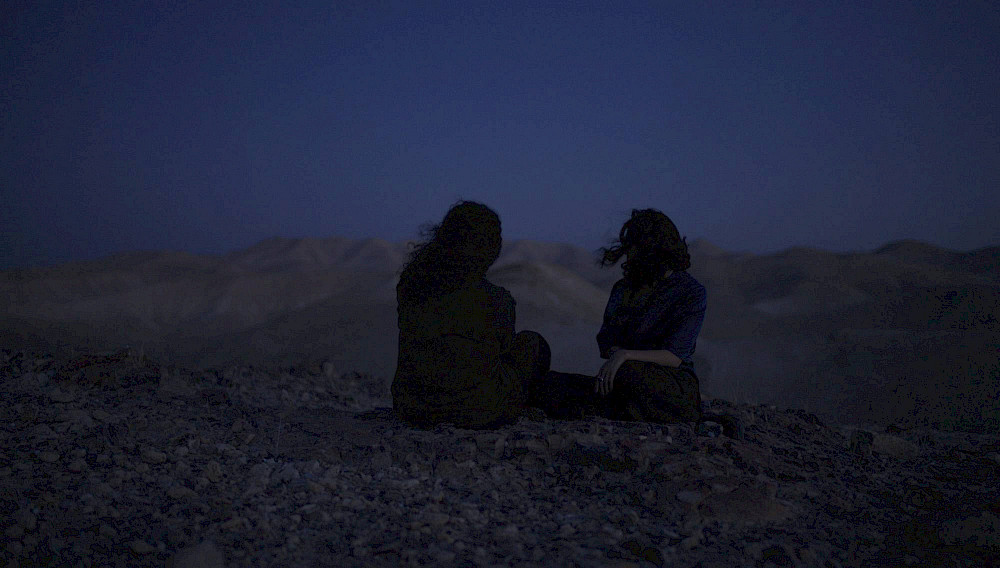
Over the past five years, Basel Abbas and Ruanne Abou-Rahme investigated songs and poems by Palestinians held prisoner in Israeli jails from 1948 to the present, reflecting on poetry as an act of resistance in confinement. Prisoners of Love: Until the Sun of Freedom is the opening iteration of this research and their first performative project.
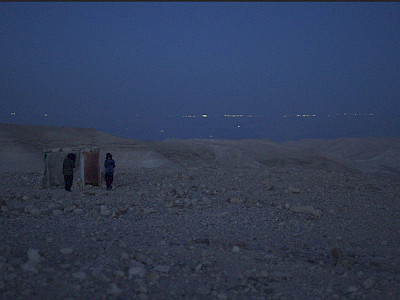
It is a visual poem of expanded cinema, drawn from firsthand recordings, interviews, and texts that reflect on the experience of the small prisons within the broader prison of Occupation. For Abbas and Abou-Rahme, who began their careers in Palestine’s music and video scene, sound is a crucial medium capable of transcending enclosed spaces. In their new piece, the power of poetry and song overflows the borders of repressive structures, and visuals break free from screens to create an immersive experience.
In La Balsamine, a former military barracks’ auditorium, this cinematic experience is accompanied for the first three days by a performance developed in collaboration with Palestinian musician Julmud. Prisoners of Love references the title of Jean Genet’s writings on Palestine, highlighting how poetry mobilises hope to collectively imagine alternative futures, so that one day prison walls may crumble to dust.
BEING THE NEGATIVE
Being the Negative
Being in the negative is being excess, excess that is invisible, excess that is disposable ¹
excess as hypervisibility ², reduced to pixel and noise
Being in the negative is being in debt, in the minus, captive to a system of dispossession
Being in the negative is being in the lack, in the break, in the site of extraction
the negative is that which is unwanted, undesirable
Being in the negative, is being short on breath, losing breath
All those who resist, all those we are indebted to, before and after us, call to us about becoming the negative
Becoming the negative is to go under, into the earth, becoming the land
Becoming the negative is becoming the sub terrain, the under terrain, all that is unseen
Becoming the negative is becoming unseen, invisible to be unbound
Becoming the negative is becoming unbound resistant, mutating, refusing
refusing that which has been refused to us ³
Being the negative is creating from the lack what is lacking, what is missing, what we need
We are in the lack and we are what is lacking
Being the negative is to see in the negative what we otherwise could not perceive, the pores of the land, the fracture at the heart of the colony
Being the negative is being the spill, being the contamination, being the excess that “fuels return” ⁴
Being the negative is to be the debt that is owed to us
Being the negative is being with what we are indebted to, all those that came before us and call to us now
call to us from within their graves; “those who chant do not die” ⁵
the call echos, call us again and again to where we must be
Being the negative is being what seems buried, but continues to sprout
Being the negative is to see the breaks as openings, to be that break
breathing and being, being and breathing where you should not be
***
PRISONERS OF LOVE: UNTIL THE SUN OF FREEDOM
To all those we are indebted to, all those that came before us and all those that will come after us
“Nothing has been willed, written or composed for the sake of a book … it is both a weapon of liberation and a poem of love.” JG
“In my twentieth year of captivity… I confess that my heart flutters at the sight of a rose on television, or a nature scene, the sea. I confess that I am still a person holding on to love as if it were embers. I will remain steadfast in this love. I will continue to love you, for love is my humble and only victory over my jailer.” WD
Walid, your words remain inside of us
Some years ago, before you were taken from us
After being imprisoned for over two decades
You said the longing and yearning was what united us
A longing for place, a longing for a time not occupied
We return to M freed after years of captivity
He walks in his land
And speaks of plants as though they are his kin
He speaks of secrets, the secret of our power
That sometimes we do not dare confess to ourselves
K.O said this is the land of secrets and magic
We write this now a letter of love to the people and the land
And this a forbidden love
And we, prisoners of this love, prisoners of this loss, prisoners of this longing
***
And this a forbidden love of the land lost, the land loved, the land loved and lost
Um al Zinnat, how beautiful you were, how beautiful you are
On a mountain top looking down to the sea of Haifa
They came to wipe you out in 1948,
When they extinguished life in over 500 villages
But who are they to you and us, us and you
Bound to one another in this wounded kinship
May 1948, May 2025
Looking at you all we see is Gaza
Muin, returns now, as though he never left
Reciting, The Besieged City, for his Gaza in 1952
“The sea whispers the tale of an imprisoned homeland to the stars, and the night, like a beggar, pounds with its tears and groans.”
L treads lightly on all that remains of Umm il Zinnat
Her graveyard and her vegetation
Muin continues, folding 1952 into 2025, folding us back into the wound
Gaza besieged again and again
“The doors of Gaza, locked upon its grieving people, wake the living who sleep upon the ruins of bygone years
The river, once a traveler rushing through mountain and valley, now casts its stick into the rubble turned to dust.”
July 2024, Gaza, the old man weeps
“They don’t want to leave anything for us.
Not a tree, not a rock, not a school
No clinic, no hospital, no people.
The ground is burned.
The land is burned.”
A wound that does not heal
A wound we share in the darkness in the silence
a wound that should break the world open
“This is the beautiful Gaza, orbiting in mourning between the hungry in tents, the thirsty in graves,
Images of indignity, rise up, imprisoned people!”
Muin’s last word a call to us to answer the call of Gaza
Being the negative is to be the debt that is owed to us
being with what we are indebted to, all those that came
before us and call to us now
call to us from within their graves; “those who chant do not die”
- Excerpts from Prisoners of Love: Until the Sun of Freedom
¹For more on this question of excess see: HajYahia, Adam. The Principle of Return. Parapraxis, April 7, 2024.
²Moten, Fred. Music against the Law of Reading the Future and “Rodney King.” The Journal of the Midwest Modern Language Association 27, no. 1 (1994): 51–64. https://doi.org/10.2307/1315058
³Moten, Fred. The Subprime and the beautiful. African Identities, 11:2, 237-245 (2013). “For, to refuse what has been refused to you, even when what has been refused is a fantasy, is only possible from the perspective of having had something (beyond the constant imposition of a lack or barrier or impossibility). But having had, in this case, is not the description of some previous, violated ownership; it is, instead, a prophecy of having given everything away (in having consented not to be a single being, in having been continually acting out [of] the massive theoretical implications of holding and being held, against ownership, in dispossessive enjoyment of the undercommon underprivilege). Everything I love is an effect of an already given dispossession and of another dispossession to come. Everything I love survives dispossession, is therefore before dispossession.”
⁴ “Slipping out and spilling into the colonial matrix, this excess is what fuels return.” see: HajYahia,
Adam. The Principle of Return. Parapraxis, April 7, 2024.
⁵A chant sung in Palestine, “Raise your hands, raise your voice, those who chant do not die”
Presentation: Kunstenfestivaldesarts, La Balsamine
Writers, directors and editors: Basel Abbas & Ruanne Abou-Rahme | Camera: Raouf Haj Yahia, Basel Abbas, Ruanne Abou-Rahme | Producer: Adam Haj Yahia | Sound recordist: Mohammed Nofal | Sound composition: Basel Abbas & Ruanne Abou-Rahme | Research: Yara Abbas | Studio direction: Tamara Khasanova | Live performance: Basel Abbas & Ruanne Abou-Rahme with Julmud
Production: The Bell / Brown Arts Institute - Brown University, Nottingham Contemporary, Kunstinstituut Melly | Coproduction: Kunstenfestivaldesarts, NW Open House for Contemporary Art and Film, Festival d'Automne à Paris