19 — 23.05.2026
Ali Asghar Dashti, Nasim Ahmadpour Tehran
Noli Me Tangere
theatre — premiere

 | Farsi → NL, FR, EN | ⧖ +- 1h20 | €20 / €16
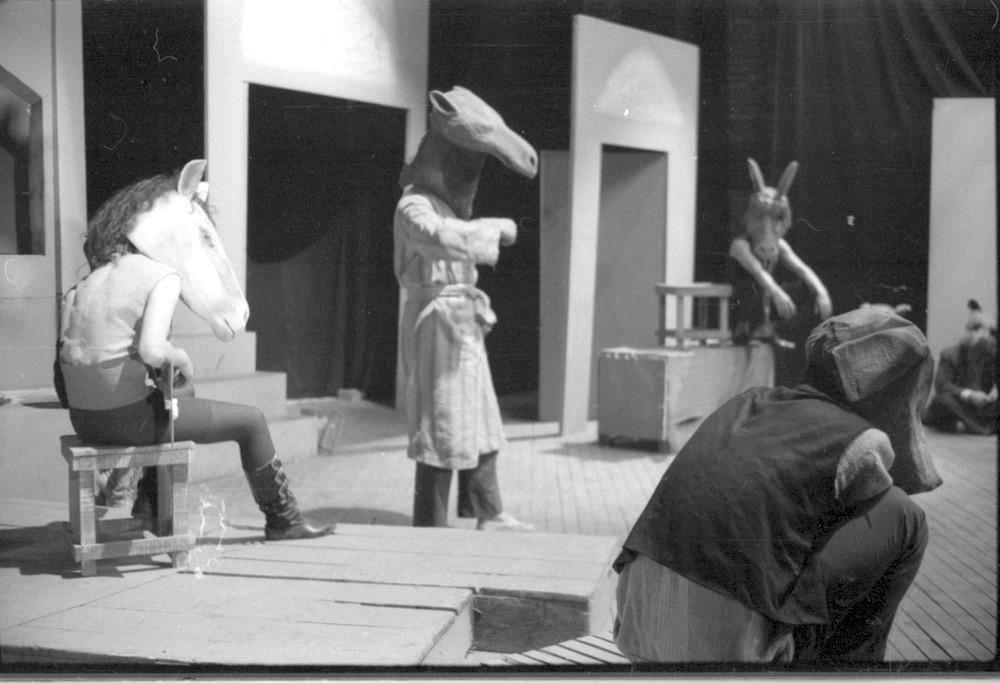
In 1966, the sociopolitical play Shahr-e Ghesseh (“The City of Tales”) was performed in Tehran. Most characters appeared as animals, with actors wearing masks. Directed by Bijan Mofid, it only ran for nine months but remains an iconic work of Iranian theatre that has reverberated across generations. In 2012, a group of political prisoners in Iran decided to restage Shahr-e Ghesseh. The "Donkey" role was first assigned to an inmate who, after several rehearsals, was freed. The role passed to another prisoner, also released soon after. This cycle repeated several more times, and with each reassignment, a mix of expectation and real life emerged on stage. Roles circulated, bodies left, but the theatre practice did not stop. What unfolded was not a narrative of prison, but a collection of moments with theatre arising from the separation of role and body.
In 2026, following the radicalism of their previous work, Dashti and Ahmadpour return to the festival with a breathtaking performance that presents theatre as an act of resistance. Noli Me Tangere (“Touch Me Not”) considers the role as something independent from the body. Here, theatre seeks to fulfil a suspended dream: the return of an imprisoned actor to the stage, while an important question is still alive. When the body is trapped, can the role become a space to rehearse emancipation?
Theatre in suspension
Notes on the role of the performing arts in Iran today
Mid-February 2026, Tehran. Nearly a hundred productions are playing—from Medea to Antigone and Three Sisters. Meanwhile, thousands have been killed by the government, the internet has been shut down for weeks, and American warships are gathering in the Persian Gulf. Once again, the Iranian people are a pawn in a ruthless power game played by power-hungry despots. Isolated from the world, director Nasim Ahmadpour asks—in fragments, because nothing else is possible—what is to become of the arts many Iranians hold so dear, and what they still mean
when the street has become a more dramatic stage than any theatre.
Tuesday, February 17, 2026 – Tehran
BBC Persian is on. The parasitic interference imposed by the government on opposition networks fills the TV with noise. It creates a space that is uncertain, anxiety-inducing, continuous, and mundane. Something that seems normal to us. But is it really normal?
I sit by the television, not at my desk. Representatives from Iran and the United States are meeting in Geneva for the second round of peace negotiations. The U.S. has deployed substantial military forces in the Persian Gulf and surrounding countries, casting a heavy shadow of war. China, Iran, and Russia have held military exercises, temporarily closing the Strait of Hormuz.
In early January, the government killed thousands of domestic protesters, detained many, and continues to arrest and even execute some publicly. Dozens of theatre people and cinema professionals were imprisoned, and several theatre practitioners I knew lost their lives to gunfire in just these two days.
We stand at a historical crossroads, where countless ideas and events intersect. Transformations unfold with dizzying speed. They vanish from the present, merge into history, and lose their contemporary relevance. Texts lag behind history; the pace of events overtakes the capacity to write. Ideas that are still forming dissolve into others before they fully mature. In this rush, analysis becomes obsolete before it is complete.
Yet, when I check Tiwall (an online ticket platform for theatre in Iran), I see around a hundred performances running: from Medea to Antigone and Three Sisters, among many others. Simultaneously, underground performances in secret private places continue in the city’s basements. In this way, all this tragic context turns into a dark comedy, enveloping me, a Tehran-based Iranian, in shock, anger, confusion, and an unnameable mix of feelings.
Over consecutive days, I have written scattered notes, each intersecting with another as it was forming. The following text has a structure derived from this fragmentation—thousands of fragments. I repeatedly tried, often in vain, to unify it, but ultimately I humbly accepted this as the text’s natural structure. This structure reflects the realities we live, and naturally mirrors the current structure of Iranian theatre itself.
A twofold theatre: official and underground
Iran’s political space is polarised and tearing apart; theatre mirrors this division. I have not attended any official theatre venues for three years—not because I shouldn’t, but because I have not wished to. Many others act similarly; some do not.
The murmurs of this divide began in 2019, when theatre groups withdrew from the Fajr festival in protest of the downing of the Ukrainian plane by the government. Their works were removed from the official stage, driving a significant part of the theatre industry underground in a process many now see as irreversible.
After Mahsa Amini’s death on September 16, 2022 (25 Shahrivar 1401), and the subsequent Women, Life, Freedom protest movement, the divide within the official arts scene widened. On September 19, the House of Cinema announced the suspension of all activities “until further notice”—a phrase inherently suspended: neither ending nor continuation; neither dissolution nor persistence. A state of being in-between.
This decision quickly spread to theatre. Performances
were cancelled; some groups announced they would not appear on stage; some released statements; some remained silent; some shared videos; some quietly withdrew. The strike, before being a cohesive labour action, became a moral gesture distributed across bodies—in refusals, doubts, and pauses.
From then on, the issue was not merely performing or not performing. Every performance, every withdrawal, every silence was interpreted. The stage became a site of moral judgment. Theatre—official or underground—entered a state neither fully halted nor uninterrupted, but continuously suspended.
The division between official theatre (with government permission) and underground theatre (without government permission) ultimately condensed into a binary: to work or not to work. To work meant complying with a suspended but still coercive law; to abstain meant refusing a law whose legitimacy had eroded, though its mechanisms remained.
This is the beginning of a situation where the law is neither entirely cancelled nor fully active, but exercised in perpetual suspension—undoubtedly an exceptional situation.
Theatre practitioners divided accordingly:
*
Those who continue in official theatre: for livelihood, to keep the official field from being abandoned, to protect past achievements, and possibly to reform the system from within.
*
Those who refuse to perform officially have various reasons. Some were unwilling, after the Women, Life, Freedom movement, to present female performers wearing the hijab on stage. More often, however, the issue is not merely the compulsory hijab—it is the very nature of state-issued artistic permission, which enforces censorship and control.
This situation was gradually becoming habitual—a crisis embedded in daily life. Some withdrew, some persisted. Underground theatre, a little earlier in time a radical and oppositional space, slowly became marginal, reaching a limited audience. Any everyday act can become normalised, even suspension, even crisis.
Taraneh Alidoosti
On December 24, 2025 (3 Dey 1404), just as the removal of protesting women from the official scene was becoming normalised, the documentary Taraneh, directed by Pegah Ahangarani, was released. The film, focusing on the professional life and political positions of the famous actress Taraneh Alidoosti, highlighted the courage and persistence of the Women, Life, Freedom movement.
Alidoosti, after years away from the stage, once again declared that she would no longer perform wearing the compulsory hijab—even at a time when some actresses who had previously removed it regretted their decision. This stance, along with the broadcast of the documentary on BBC Persian, sparked intense debate within the artistic community and resisted the normalisation and forgetting of acts of defiance. Taraneh shone without performing, moving from the margins to the centre of the artistic scene against the tide of oblivion.
It reminds us that while the theatres are open and festivals continue, some bodies are absent—not because of closures, but because of exclusion. The legal framework simultaneously preserves and denies access, turning the performer’s body from an agent into a subject of power. Political stances transform the actor from a cultural figure into a political matter. This shift is not merely personal but signals a deep rupture in the structure of official art.
The actor’s body is present on stage yet removed. Presence carries absence.
Rupture: Massacre February 3, 2026
Following the Women, Life, Freedom movement and immediately amid a new wave of protests, the authorities forcibly cut off the internet for nearly three weeks. Now, after almost three weeks, the connection is slowly and weakly returning. It feels as if I have been detached from the world. The world is no longer as it was. Theatre? I don’t know. I spent the past two weeks watching the series Stranger Things, a fantasy irrelevant to my surroundings and artistic taste, but now tolerable and soothing.
Meanwhile, thousands have been killed. People mourning in shock and under government pressure have begun dancing at the funerals of their lost loved ones; a new form of mourning has emerged. Theatre seems to have returned to its ritualistic and primordial origins, redefining itself and offering some relief to people’s suffering within a postmodern ceremonial context. Crying is not the answer—dancing is.
In the midst of these tense days, I watch Iran International TV, where three guests discuss war and negotiation, trying to understand why Iranians might wish for the U.S. to drop bombs on them. One guest comments: “During the Balkan wars, the Serbs wished the same.”
I think of Susan Sontag, who staged Waiting for Godot
in Sarajevo, in the midst of war and siege, interpreting Beckett’s philosophical waiting as a form of everyday life while in anticipation of the end of the conflict. But if performance is a co-presence of bodies—an event that transforms the energy between actor and spectator—what does this co-presence mean in a city where bodies in the streets are targets of gunfire? Tehran is not Sarajevo, yet the question remains: is the theatre hall a denial of the street, or does it offer some respite from it?
Suspension and the redefinition of the stage
Today, Iranian theatre stands in suspension. The stage no longer has a single centre. It exists multicentrically: official halls, suspended projects, and the street as a direct scene of history.
Theatre is no longer merely a cultural institution; it is a moral and political matter. Writing, performing, or recording incapacity are all forms of being in history. We are learning to live in incompletion, practicing existence in instability. This is itself a form: a form of perpetual ambiguity. In Iran, crisis is chronic, and theatre lives in chronic crisis.
Suspension has lasted so long that it can no longer be called a transitional stage. Law is neither repealed nor enforced. Performance is neither fully forbidden nor free. Theatre is alive—and not.
This situation is neither total blockage nor definitive formal revolution, but an in-between constantly shifting. The stage itself becomes a site of inquiry. The street is a dramatic scene where bodies are involuntary and danger is part of everyday mise-en-scène. The theatre hall risks irrelevance—but the issue is not competition between these stages; it is the displacement and fragmentation of the stage itself.
Today, Iranian theatre is redefining itself. Performing can be resistance or normalisation; abstaining can be ethical posturing or voluntary removal. No choice is pure or without contradiction. When the street becomes a more dramatic stage than the hall, the question is no longer should we perform—it is where should we perform?
- Nasim Ahmadpour
- Published on the website of Etcetera on 27 February 2026
Presentation: Kunstenfestivaldesarts, Beursschouwburg
Writer and director: Ali Asghar Dashti | Dramaturg: Nasim Ahmadpour | Performer: Hossein | Voice performers: Golshan Panahian, Ali Asghar Dashti, Mahsa Dehghanipour, Ilnaz Shabani | Music and sound designer: Bamdad Afshar | Trumpet pieces performer: Saeed Nabaei | Mask design and construction: Homa Sadatian | Lighting designer: Niloufar Naghib Sadati | Video designer: Mohammad Reza Rahmati | Graphic designer: Farhad Fazooni | Assistant directors: Fatemeh Rouzbahani, Hossein Khodaei | Technology: Jafar Hejazi
Production: Don Quixote Theatre Group & Interdisciplinary Cultural-Artistic Institute Names and Signatures | Coproduction: Kunstenfestivaldesarts
The initial version of this text was written in the winter of 2024 at the Cité des Arts Residency in Paris