21 — 24.05, 26 — 28.05.2026
Boris Charmatz, Terrain Brussels-Hauts-de-France
Muette
dance — premiere

 | ⧖ 50min | €20 / €16 | Contains nudity, 16+
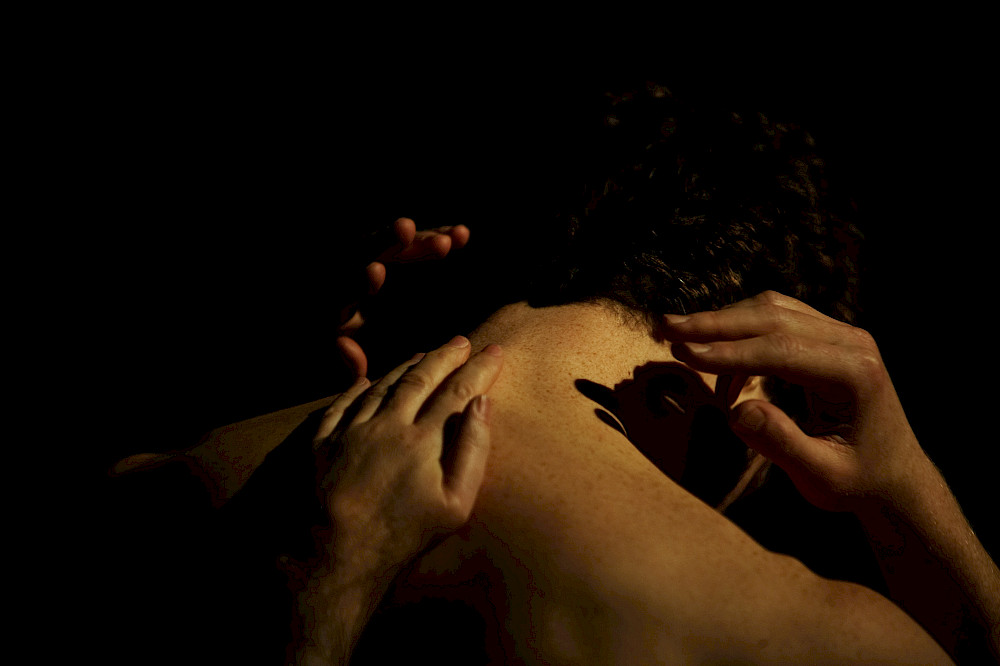
A dancer moves with his mouth wide open, appearing stupefied. No sound emerges, as if the body were in a state of apnea. For this most anticipated solo, premiering at the festival, choreographer and dancer Boris Charmatz creates an atmosphere of total silence, moving furtively, as if dancing inside the stillness he produces.
Known for his extraordinary expressive range, Charmatz balances virtuosity with the vulnerability of raw exposure: naked, extremely close to the audience, he allows fleeting images to cross his body. The silence present from the start gradually becomes the stage on which sounds of the body are heard: breaths, jolts, slips, falls, and muffled voices. Moving from obscene to ecstatic gestures, he seems to be accompanied by music that is absent yet somehow liberating.
In an age of overstimulation, dancing in silence is not simply moving without music—it opens a door, and the lips, to an inner world of expression, where a parted or closed mouth shields an abyss of suspended emotions. Each night, in the intimate space of Kaaistudios, Charmatz recreates a shared proximity in which a body seems on the verge of revelation, and uncovers the precious, fragile tremor of a moment we might share.
Muette
Interview with Boris Charmatz
Gilles Amalvi – This new solo, Muette, delves into the question of silence, both as a material and as a failure of expression.
Boris Charmatz – Orality has occupied a particular place in my work for a very long time. For me, the mouth is a part of the body—like any other part a dancer uses—but it is far too often excluded from the choreographic field. When I began working on Muette, my intention was to work on silence; but I gradually realised that the face—and the mouth in particular—was the focal point of this dance, its point of articulation. Something, at that precise place in the body, is stuck, blocked, does not come out.
The orality you refer to—present throughout your choreographic work, as in manger (2014)—is an expanded orality. It is not only the mouth as a site of emission (speech, song, cry), but also a crossroads of exchange: a place where things enter and leave.
I was initially trained in classical dance. In classical technique, the face is expected above all to express ease and seduction, while repressing the effort that this virtuosity requires—the pain, the fatigue. Perhaps it is a reactive mechanism, but for me, the face is part of the dance. In héâtre-élévision (2002), I worked with grimaces—as masks that generate movement: the face as a mask producing specific postures and ways of dancing. This mechanism crystallises in Muette. It is no longer the face that participates in the dance; rather, the dance itself unfolds from the face. The face often functions as a membrane, a filter for what we imagine to be the dancer’s experience— and this, in turn, helps us read the dance. Facial expression influences how we perceive movement. That is why, in classical dance, one smiles: the smile reassures. In Muette, I want this filter, this membrane, to absorb everything. Many of the movements in Muette are not facial movements—but almost everything passes through the mouth.
Does the solo form make it possible to zoom in on this area of the body? What does that form allow you to explore?
The solo form is extremely poor—it can be made with almost nothing. In the case of SOMNOLE (2021) and Muette, these are very reduced solo forms—almost desert-like: no music, no set, almost no light. The idea is to strip things to the bone, to see what remains: almost nothing, just breath. As a child, I was asthmatic; I had to control my breathing in order not to suffocate. I would not say that Muette is an “asthmatic solo,” but it is a choreography of breath—of air going in and out—that places the fragility of that mechanism at the centre. And that is something very much linked to my own experience. Making a solo today is also a form of limitation. I am fifty-three, and I can no longer dance the way I did at twenty. For me, this experience is closer to that of a writer facing a blank page. Of course, the blank page doesn’t exist—even more when it comes to the body. But there remains the fragility of being alone with oneself: the tip of the pen poised over the page, from which a story, a poem, a line, a word, a non-word might emerge. You cannot know in advance what the first letter will be—and that letter can set everything in motion. It is as frightening as it is exhilarating.
The title, Muette, is feminine. What is mute—or mutated—in this piece?
The title is simply une danse muette, a silent dance. It was undoubtedly a way of stepping back from the personal dimension to focus on the dance itself. At first, I wondered whether I should invent a dance that produces no sound at all. There is a long section that follows this principle: the entire passage in which I dance with a bubble of saliva on my lips produces very little sound—because sound is generated by accents in movement; and if there are accents, the bubble bursts. So the constraint of the bubble effectively creates a nearly silent dance. But it limited my exploration of movement, so I did not apply it to the entirety of the solo.
I also wondered whether to hand out headphones or earplugs to the audience, in order to produce an absolutely silent experience. Or to build a scenography using soundproofing. But my solo reverberates, because a body reverberates—and that sound is all the more perceptible when the dance takes place in silence, without music. This noisy silence creates tension. In the end, I work with this idea of a silent dance—but more as a mental horizon than as a goal to reach. The film Into Great Silence about Carthusian monks who take the vows of silence; anechoic chambers; and Beuys’s felt rooms that absorb sound left a profound mark on me. But so did more trivial things, like mime classes at the Paris Opera.
A number of movements in Muette evoke an imaginary linked to confinement and trauma. What was it like working in the studio? What guided your imagination?
I shut myself away in order to work. A great deal emerged from the blank page. After a period of work at La Briqueterie, during a public showing, I was asked to speak about what had passed through me during these improvisations. I find myself wondering to what extent these affects, these intimate zones, need to be named. Should one spell out something that is trying to remain mute? One image, for instance, crystallises the relationship between the unspoken and explicitness: at the beginning of the piece, I undress in a corner of the studio. At first, this image came from a practical concern: I did not want to arrive on stage naked, but I also did not want to undress in the middle of the space. So I thought, “I’ll undress in a corner.” Once that image was there—undressing in a corner—something tipped toward a more explicit image, evoking being “sent to the corner,” and, by extension, the violence inflicted on children’s bodies. More broadly, I would say there is a thread running through the piece that leads back to childhood—on the side of constraint, but also of play. The image of the saliva bubble refers to games we play as children. But it also refers to being frozen, unable to move, since any movement can burst the bubble at any moment. It is an image that speaks to me strongly, precisely in relation to fragility.
Muette, both in its physicality and its aspect of rawness, comes close to performance art. Is there a porous zone between dance and performance in this solo?
I see many dance works today using spectacular elements in a very straightforward way, with a clearly defined tempo—a big beat that structures everything; unison dances that are very close to club culture. I would rather see a dance that is searching, even if it is rigid or demanding, than something easy and polished. From that perspective, the radicality of performance art is a major source of inspiration for me. At the same time, I am a dancer, a choreographer, and my work does not quite operate in the same place. I could probably improvise a twenty-minute version of Muette in a performative mode. But instead, I have been working on this form for more than a year—not necessarily to choreograph the material in a meticulous way, or to freeze it, but because I need to soak in it. One of the driving forces behind Muette is the fact that we are constantly bombarded with tragic information—and it keeps getting worse. War, the crisis of democracies, the climate crisis… Muette is not a response to current events, but perhaps a way of absorbing them, of giving form to that magma of news. Muette is the state this puts me in. It is not a declarative or denunciatory piece, but a piece that conveys what this does to me. What the body endures. I hope that, despite everything, the solo remains luminous—fragile, but luminous, like a bubble of saliva holding a cry that cannot
quite burst.
- Excerpts from an interview by Gilles Amalvi in December 2025
- Translated by Ela Kotkowska
- Gilles Amalvi is a French author, dance critic and sound designer. As a writer, he was associated with Musée de la danse, and he collaborates with choreographers like Boris Charmatz, Jérôme Bel, Maud Le Pladec, Anne Teresa De Keersmaeker, Latifa Laâbissi, Ivana Müller, Pol Pi and others.
Presentation: Kunstenfestivaldesarts, Charleroi danse, Kaaitheater
Choreography and performance: Boris Charmatz | Choreographic assistant: Magali Caillet Gajan | Lighting: Yves Godin | Stage manager: Fabrice Le Fur | Deputy director Terrain: Hélène Joly | Direction of productions: Lucas Chardon, Martina Hochmuth | Production manager: Briac Geffrault | Production assistant: Lola Serre
With the support of Dance Reflections by Van Cleef & Arpels
Production and distribution: Terrain | Coproduction: Kunstenfestivaldesarts, Charleroi danse, Sadler’s Wells, Tainan Arts Festival, MC93 - Maison de la Culture de Seine-Saint-Denis, CND Centre national de la danse, le phénix - scène nationale de Valenciennes, Festival d’Avignon, Tanztheater Wuppertal Pina Bausch, Chaillot Théâtre National de la Danse, Romaeuropa Festival, Cango Centro produzione della danza Firenze, ImPulsTanz - Vienna International Dance Festival
With the support of the Ammodo Foundation, la Chartreuse de Villeneuve lez Avignon - Centre national des écritures du spectacle, la Briqueterie CDCN du Val-de-Marne, Centre Pompidou - Metz, Espace Pasolini, le Gymnase CDCN - Roubaix Hauts-de-France
Terrain is supported by Ministère de la Culture - DRAC Hauts-de-France, and Région Hauts-de-France.
Boris Charmatz/Terrain is associated with Maison de la Culture d’Amiens.