21 — 24.05.2026
Janaina Leite São Paulo
História do Olho
theatre

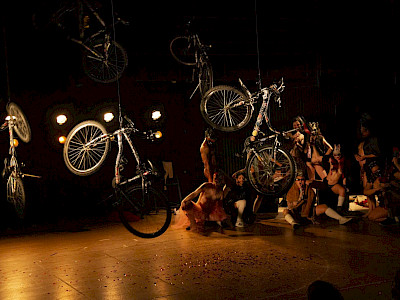
 | Portuguese → NL, FR, EN | ⧖ 2h40 | €22 / €18 | Contains nudity, references to sexual violence, live sex, body suspension, 18+
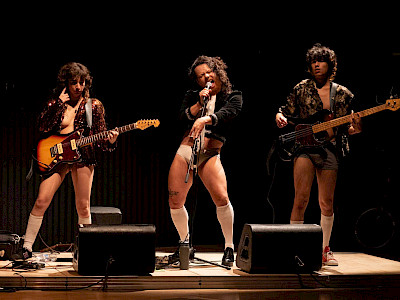
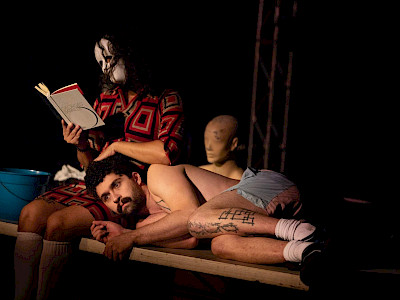
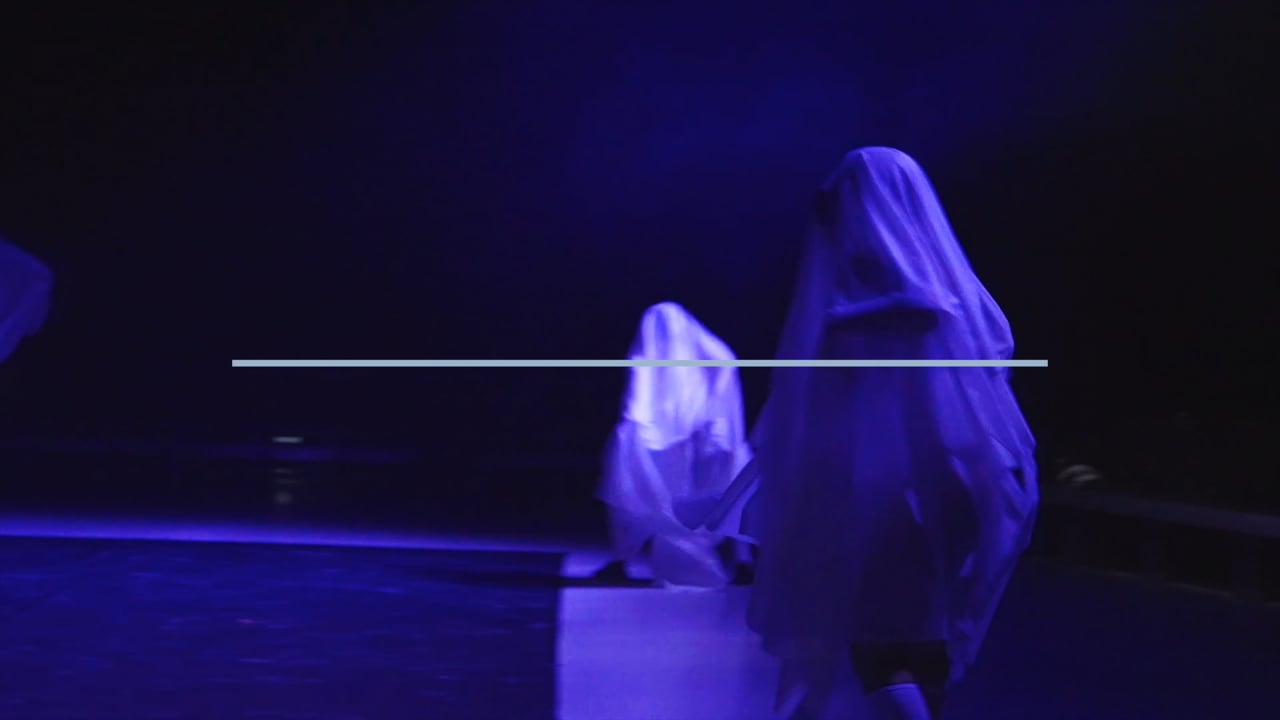
Inspired by Georges Bataille's scandalous novella of the same name, theatre maker Janaina Leite explores the relationship between theatre and pornography. The play follows the structure of the book to tell the story of three teenagers and their sexual escapades. Working with the Núcleo do Olho, Leite—one of the most intriguing artists in Brazilian theatre—recreates this dark fable as a magical, at times festive, experience. In a fairy-tale setting, it shifts between the vulgar and the sublime, the mundane and the cosmic, the ordinary and the abysmal.
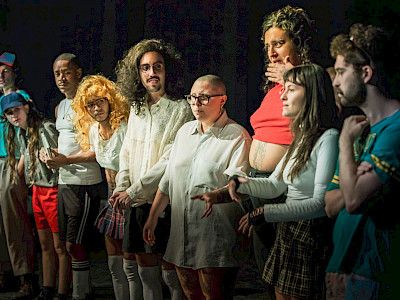
Twelve performers—professional and amateur, some of them sex workers—take the audience on an intense, three-hour experience, with live music, theatrical storytelling, and live pornographic scenes. Leite and her cast enter into an intimate relationship with Bataille's work, inviting the audience to do the same. Pornography becomes a theatrical form through which vital and destructive impulses are examined.
História do Olho (“Story of the Eye”) explores taboos and questions our relationship with shame and lust, seeking collective insight and consent through performative transgression. Part subversive pornographic fairy tale, part radical adventure, it is a fundamentally tender and connecting piece of theatre that re-educates the gaze.
"['Story of the Eye' is one of] The Most Surprising Avant-Garde Works of Theater" Juan A. Ramírez, 2026, New York Times
História do Olho
It was on the advice of his analyst that Georges Bataille wrote the celebrated Story of the Eye. Writing under a pseudonym, the 23-year-old librarian used literature as a space for disguise and metamorphosis to give vent to the acute anguish that gripped him in his relationship with sexuality. And thus, he wrote this “sadistic, pornographic, and juvenile” novel, as he himself put it. Years later, Bataille claimed that writing this work had transformed him, turning him from the “utterly sick being” he was into someone relatively stable.
Bataille adopts an almost programmatic approach in transforming the aesthetic (which evokes taste) into the negative aesthetic (which evokes desire, pain, and revulsion), by combining, in this gory fairy tale, the dimensions of the sublime and the abject.
I first came across Bataille when studying French literature at the Faculty of Arts, and years later I was drawn to the theme of sacrifice that runs through his work, as well as to his interest in the static states of consciousness. “I offer a challenge, not a book” is one of the phrases that struck me whilst reading another of his works, Inner Experience, published in 1943. “I write for those who, upon entering my book, would fall into it as into a hole.” And he adds: “I wanted to write a book from which no easy conclusions can be drawn.”
My exploration of the realm of pornography begins with Stabat Mater (2019), then takes a dizzying detour through the experience of Camming 101 noites (2020), and culminates in the experiments carried out by Núcleo do Olho during the pandemic, which gave rise to História do Olho – a dark porn fairy tale, our take on Bataille’s Story of the Eye.
For me, bringing pornography to the theatre means taking on a challenge from which no easy conclusions can be drawn.
Finding partners who not only rose to the challenge but took it far beyond the scope of Bataille’s “low materialism” is undoubtedly one of the most significant events of my artistic life.
Recently I was asked about the real autonomy and agency of the performers in the face of the “extreme” acts—their words—that take place in the performance. They were referring in particular to the “fisting scene” crea-
ted and performed by Isabel Soares. I couldn’t help but smile to myself, and even feel a certain pride as I imagined what she, and all the others, would say at the slightest suspicion of alienation in this process.
Janaina Leite, April 2026
***
In May and June 2026, four years after the premiere of História do Olho, I will once again address the question of my relationship with pornography. I will listen to my stage partners recite their favourite passages from Georges Bataille’s novel and to them explaining, each in their own (very particular, incidentally) way, how they relate to pornography. We will also pose this question to the audience. After all, even if it seems non-existent, we assume that a relationship with pornography does indeed exist.
This implies the assertion that pornography is, in a certain sense, familiar, characterised by the ambivalence between acceptance and unacknowledged erotic sensations. Its place within culture bears witness to this dynamic: masturbation, sex work, the field of feminist criticism and that of artistic experimentation. If pornography imposes its presence and shapes our imagination more than we are prepared to admit, it’s because it demands that we acknowledge the power of its spell: to reach, inescapably, the flesh. And would it, moreover, be desirable to renounce the lustful stimulation of the images and sexual practices that pornography deals with? From a moral standpoint, some would answer yes. But we know that this cannot be done without the cost of desensitisation—which fuels both saturation and total denial. At this stage, I suspect that pornographic images retain a certain resemblance to images of horror. They look back at us, making us the objects of a gaze inscribed in history, in what still persists in unsettling us, calling into question the idea of a self in control of itself and its own desire.
Bataille describes the eye as a “cannibalistic delicacy”, an object one might scoop up with a spoon. Here, seduction centres on the material itself (though he warns that “extreme seduction probably borders on horror”). In one of the book’s afterwords, Roland Barthes argues that Story of the Eye is the story of an object: an eye that migrates towards other comparable, though not identical, objects. One need only follow Bataille’s chains of association, which run in a hallucinatory manner from the body to the cosmos (and vice versa): eye—egg—testicles—sun—urine; saliva—sweat—semen—the Milky Way; an egg—a gouged-out eye—a skull—the celestial vault; the sun gazed upon—the sun that blinds—a man who slaughters a bull; infinite space—a cock’s crow; an eye-object, which persists and varies, jumping from image to image. I venture to suggest here that if Bataille had been asked about his relationship to pornography, he would have said that he’d pushed his obsession with the “intensive regime of matter” (his own words) to the point of encountering an eye that not only sees but intensifies the gaze—from which he experiences a “dazzling joy”.
Our fairy tale (as Janaina likes to point out) might be seen as a link in Georges Bataille’s chain of associations, sharing the status of a narrated, observed object. That does involve risks, it’s true. But these risks are perhaps less linked to explicit acts and to what we do—of our own free will and with great excitement—with our skin and our orifices on stage. It is, moreover, symptomatic of a rather narrow view (though, unfortunately, unsurprising) to reduce the performance to these moments in order to justify more or less veiled censorship. The risk lies elsewhere.
The fact is, that in the interplay between the eye and the object, there is no centralised, stable, or coherent subject. It stems from the eye’s dazzling joy in moving freely, without being overly constrained by positions of knowledge and power. In other words, in our relationship with pornography, we accept that we lose a little of our sense of self. Perhaps in favour of an encounter with a strange, amorphous, wavering dimension which certainly makes us vulnerable in the face of the other, but which, at the same time, expresses a desire for connection. This is the stuff of which História do Olho is made. With each new season, we are reminded that this connection is not guaranteed. Nevertheless, we continue to place our hopes in it.
- Isabel Soares, April 2026
- Isabel Soares is an actress, performer and psychoanalyst, with a Master’s degree in Cultural Studies from the University of São Paulo. Her artistic practice and research focus on the relationship between image, pornography, and non-conforming sexualities. She is part of the cast of História do Olho.
- Translations by Jodie Hruby
Presentation: Kunstenfestivaldesarts, Les Halles de Schaerbeek
Concept, dramaturgy and direction: Janaina Leite | Performers-creators: André Medeiros Martins, Armr’Ore Erormray, Carô Calsone, Cusko, Georgia Vitrilis, Ian Figlioulo, Isabel Soares, Janaina Leite, Lucas Scudellari, Tadzio Veiga, Ultra, Vini The Kid | Dramaturgy and assistant direction: Lara Duarte, André Medeiros Martins | Suspension performance: Georgia Vitrilis, Pamkhada, Pombo Morcego, Unificarte.Brasil and guest artists Sekretzpektrum, Nube, Burning Moon Body Art, Scalpel Priestess | Original songs and live music: André Medeiros Martins, Ultra Martini, Vini The Kid | Lighting design: Wagner Antônio | Costume design: Melina Schleder | Music production: Mateus Capelo, Renato Navarro | Original soundtrack: Renato Navarro, Vini The Kid | Sound design and operation: Renato Navarro | Body training and technical direction: Lara Duarte | Scenic construction: Edson Luna, Wanderley Wagner da Silva | Mannequin conception: Tadzio Veiga | Lighting operation: Felipe Tchaça | Stage management and production assistant: Leticia Karen | Original production management: Carla Estefan (Metropolitana Gestão Cultural) | Production management and distribution: Ariane Cuminale (VUELA)
Production: Núcleo do Olho & VUELA | Coproduction: MITsp - Mostra International de Teatro São Paulo
Presented by: Prêmio Zé Renato para a Cidade de São Paulo (Zé Renato Theatre Prize)
With the support of Teatro Mars, Centro Cultural da Diversidade, Zé Renato Theatre Prize