25 — 29.05.2026

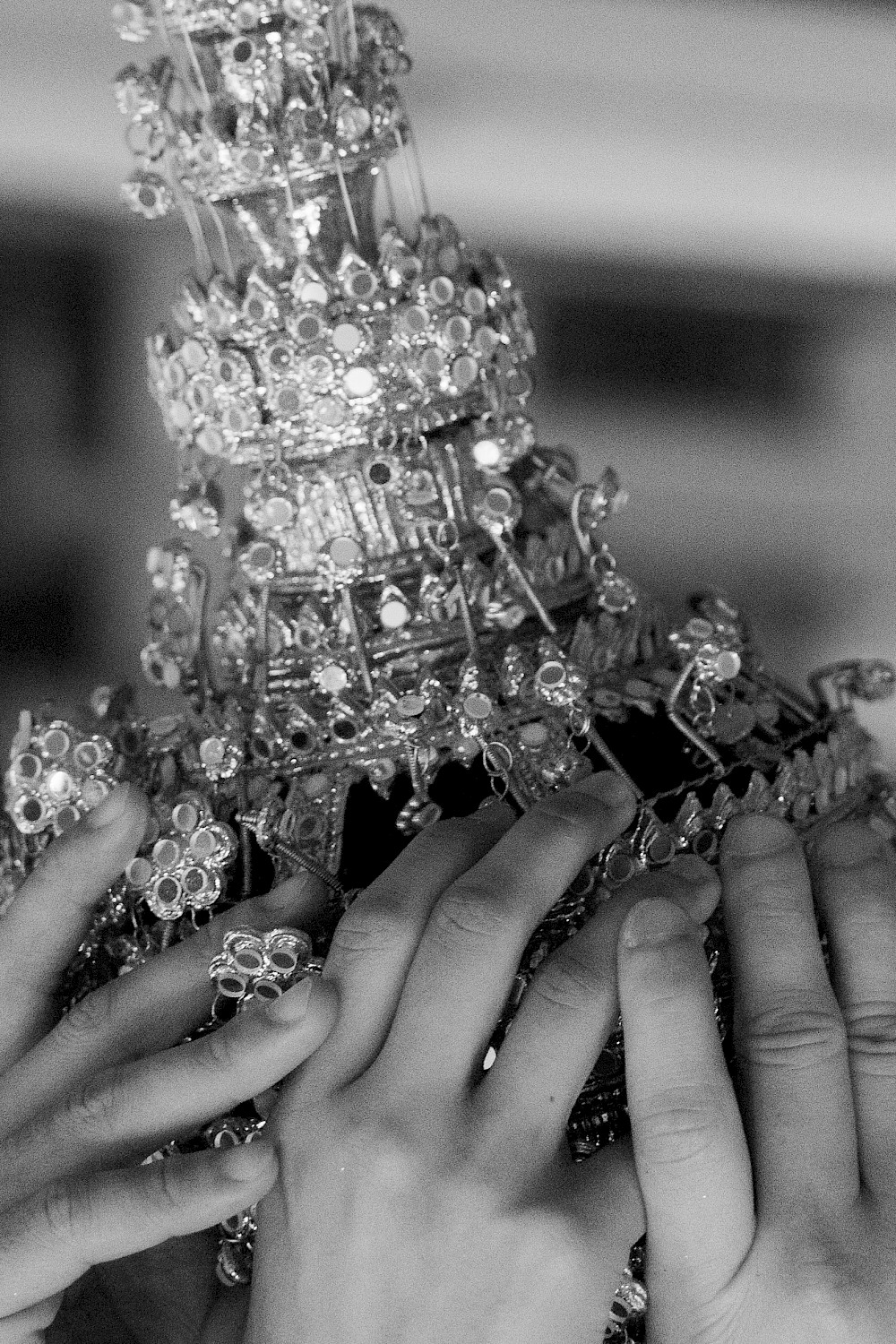
With its distinctive spire and gold colour, the chada is a headdress meant to resemble the crown of the Thai king, a holy symbol of royalty and divinity. How might one relate to the chada if it did not represent a crown? Choreographer Thanapol Virulhakul presents a delicate and quietly subversive project in which four bodies explore the chada. Their movements respond not to its history but to the shape and weight, as if encountering it for the first time.
They trace its contours across their body parts, shaking them only to explore the trembling pendants. Building on his previous research on fetishism—where pleasure is guided by the object—Virulhakul opens a space to imagine other radical relations with a crown. It passes from hand to hand in a shared act of subversion, a hint of democracy; it becomes a bodily attribute, a tool, a megaphone. It leads the dancers into sensual gatherings or barricades, echoing Thailand’s recent coups and uprisings.
Performers become comrades, their shadows merge into a single mass, and the crown dissolves into one element among many in the social body. Invoking Lenin’s notion of revolution as a miracle, Virulhakul creates an unbelievable moment in which the chada is handled with both nonchalance and care, fully aware of the politically explosive gesture.
COMRADE
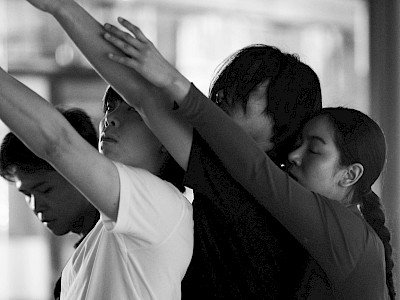
EN Comradeship in this work is a radical departure from conventional notions of unity. Rather than forming through shared goals or synchronized action, it unfolds through a choreographic logic of replacement. One dancer’s movement is not simply imitated, but taken over, transformed, and carried forward by another. The result is a fragile, flickering continuity—a collective body that is never whole, but always in motion, always in the making. Gestures are passed on not in unison but through interruption and continuation: a snapping hand mutates into a twisting torso; a lifted foot yields to another’s shoulder. A rhythm emerges from these overlapping, borrowed impulses, dissolving individual boundaries into a shifting assemblage of bodies—singular, yet profoundly entangled.
Unlike typical collectives that rely on harmony or mutual agreement, these comrades dissolve into one another’s time, space, and anatomy—forming a shifting assemblage of bodies that are at once singular and shared. Here, comradeship is not unity, but the continuous act of sustaining what would otherwise disappear.
MIRACLE
This unique form of comradeship gives flesh to the project’s central provocation: revolution is a miracle. This juxtaposition challenges the conventional view that faith and belief are obstacles to the fight. What if revolution truly is a miracle, not just a picture of oppression or mass uprising?
Captivated by Lenin’s statement about revolution and miracles, Thanapol Virulhakul set out to explore the very nature of revolution and its process. What happens when we engage in revolutionary acts as a miracle collectively ‘performed’?
A miracle is not divine, but improbable—a rupture in the expected order. In this performance, the miracle is not a sudden salvation, but a slow, collective becoming. Like revolution, the choreography relies on unstable persistence, on movements that refuse to vanish by being continually carried, reshaped, and renewed. The dancers’ fragile continuity mirrors the resilience of revolutionary struggle: not unified, but sustained through constant adaptation and the will to continue. The miracle lies in how a transformative force—capable of unsettling what seems unchangeable—can emerge from this flickering, decentralized, and unfinished collective body.
CURSE
Amidst this choreography of flickering continuity, the Chadā remains—a fixed point surrounded by a body that is anything but fixed.
Like the institutions of power in Thailand, the Chadā (Thai traditional headdress) bears holiness, righteousness, and revered legacy that are never to be questioned. Narrow codes of conduct govern how it is handled, and disobedience results in social punishment and moral shame.
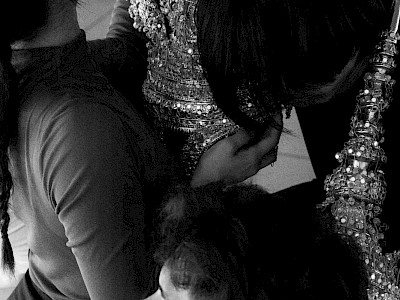
Traditionally belonging to a single body—worn to designate status, sacredness, or authority—the chada in this work is never possessed, never worn. Instead, it is approached, surrounded, and moved with by a body that is shared, shifting, and collectively sustained. Each encounter—partial, improvised, and unfinished—pulls the object into new, unstable meanings. It is not passed from hand to hand, but slowly absorbed into the rhythm of replacement, shaped by proximity rather than possession. In this space, the chada is no longer set apart; it is slowly being transformed by collective presence and movement.
Written by Thanapol Virulhakul and Sasapin Siriwanij
***
Thailand has experienced intense political dynamics in recent years, including mass protests since 2020 demanding monarchical reform and further democratization, which were met with states of emergency and state repression. While the monarchy is upheld as a national symbol protected legally and culturally, waves of student and civil demonstrations have demanded political openness and governmental accountability. Thailand’s government, shaped by the pressure of previous military coups (such as in 2014), reveals a long and turbulent history between monarchical order and popular demands. This exposition made clear that state, power, and body in this work function as lived and absorbed materialities.
Thanapol then explained the creative process through a methodology they articulate as receive, relay, realign, replace, renavigate. This mode of working feels like an effort to care for social experience so that it can be processed performatively: receiving existing tensions, relaying them as dramaturgical energy, realigning bodily priorities, replacing material positions to reload meaning, and then re-navigating spatial and temporal relations between audience and work.
The second stage—the performative presentation—made all of these explanations materially operative. The performers moved extremely slowly, each holding a small lighter in their hand. The lighter functioned as a minor object demanding attention: fragile, easily dropped, and containing only potential. When a lighter slipped from a performer’s grasp, there was no dramatization or correction. The fall instead opened up time—a space to sense how seconds are stretched, held, and loosened, allowing the audience’s imagination to begin working.
At certain moments, the performers moved at different tempos. Some remained bound within a slow collective formation, while others began to break the rhythm, taking distance, turning in divergent directions. Their gestures were not uniform. Their tempos were not synchronized. The bodies appeared like small points on a map—moving along side routes, stepping out of marching orders without fully severing relations. This asynchrony was not disorder, but another form of togetherness: a collectivity that does not demand simultaneity, but allows different rhythms to coexist.
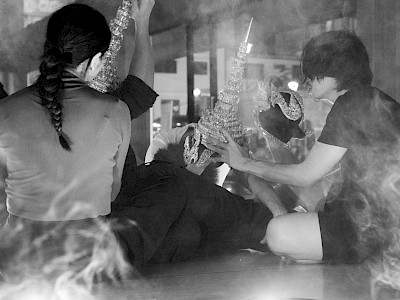
The most materially and symbolically powerful moment emerged when the performers moved toward three crowns mounted on metal poles—solid, tall, and seemingly immovable. There was no frontal gesture of opposition. They approached only with a highly controlled rhythm—clearly not the rhythm of power. The crowns were then taken and placed on unconventional parts of the body: in the mouth, on the chest, at the waist, on the feet. The crown, long considered legitimate only on the head, underwent a redistribution of meaning as it was touched, held, and relocated by bodies.
At this point, I did not read the action as a profanation of symbols, but as choreographic labor that renegotiates the relationship between body and power. The crowns became heavy, disrupted balance, forced bodily adjustment. Power was not overthrown; it was deferred. Its force was held back. Its aura loosened. By extending the duration of touch and movement, the performers created another time—a time that renders the present insufficient, too narrow, too saturated with fear and acceleration.
- Excerpts from Deferring the Miracle: Notes from “Comrade, Miracle, Curse” written by Taufik Darwis in the context of a discursive-performative showcase of the piece during YPAM (Yokohama International Performing Arts Meeting) in Japan, December 2025
- Taufik Darwis is a Bandung-based curator, dramaturg, and performance practitioner. He is a founding member of the BPAF Foundation and the Dramaturgy Assembly, and an early member of the Garasi Performance Institute. He initiated Pseudo-Entertainment, a practice research and performance platform based in Bandung.
Presentation: Kunstenfestivaldesarts, La Bellone
Concept and choreography: Thanapol Virulhakul | Performers and collective choreography: Paopoom Chiwarak, Thongchai Pimapunsri, Surat Kaewseekram, Wayla Vawynn, Spirits and Non-human beings | Art direction: Pornpan Arayaveerasid | Costume design: Nicha Buranasamrit | Visual archive and research: Withit Chanthamarit, Kanitpannee Nimsrithong, Paopoom Chiwarak, Thanapol Virulhakul | Technical operator: Piti Boonsom | Stage and project manager: Peerapol Kijreunpiromsuk | Producer: Sasapin Siriwanij
Co-commissioned by Ghost Foundation, OPEN FIELD and BACKROOM | Special thanks to Buffalo Bridge Gallery, DuckUnit, Solid