20 — 23.05.2026



What happens to the body when collapse becomes a condition rather than an exception? For years, choreographer Leu Wijee has researched everyday life of places in the aftermath of natural disasters, observing how bodies and environments absorb shock, memory, and renewal.
Wijee is from Indonesia, a country increasingly affected by rising sea levels and the impact of human-caused global warming. His hometown in Central Sulawesi was devastated and reshaped by a 2018 earthquake and ground liquefaction. This research expanded through an encounter with dance artist Mio Ishida, whose practice explores bodies, objects, and the landscapes she inhabits in Tokyo and Chigasaki. Together, they created RIDDEN.
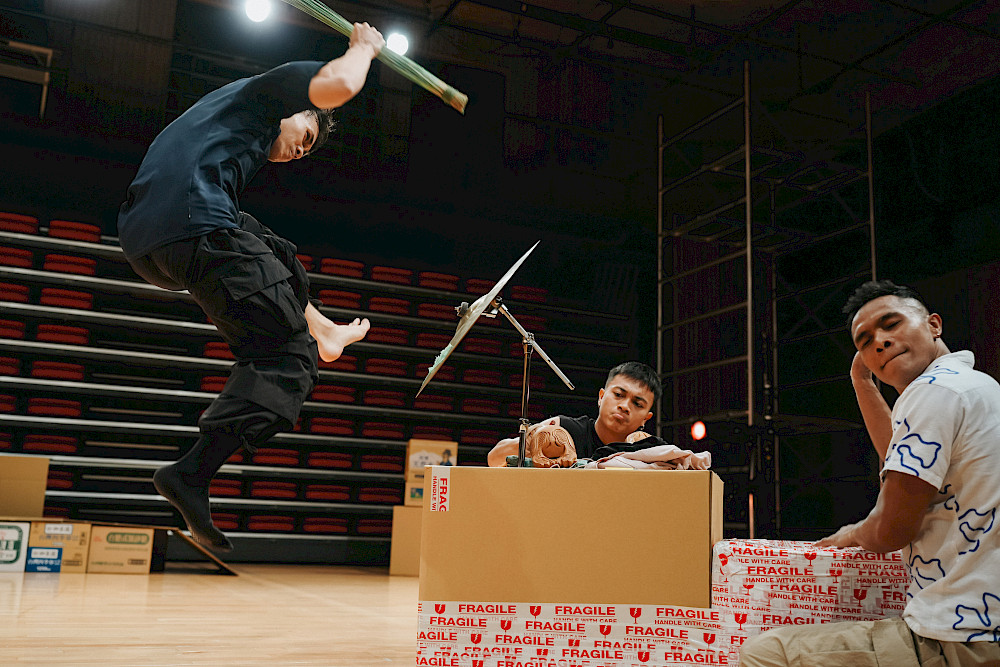
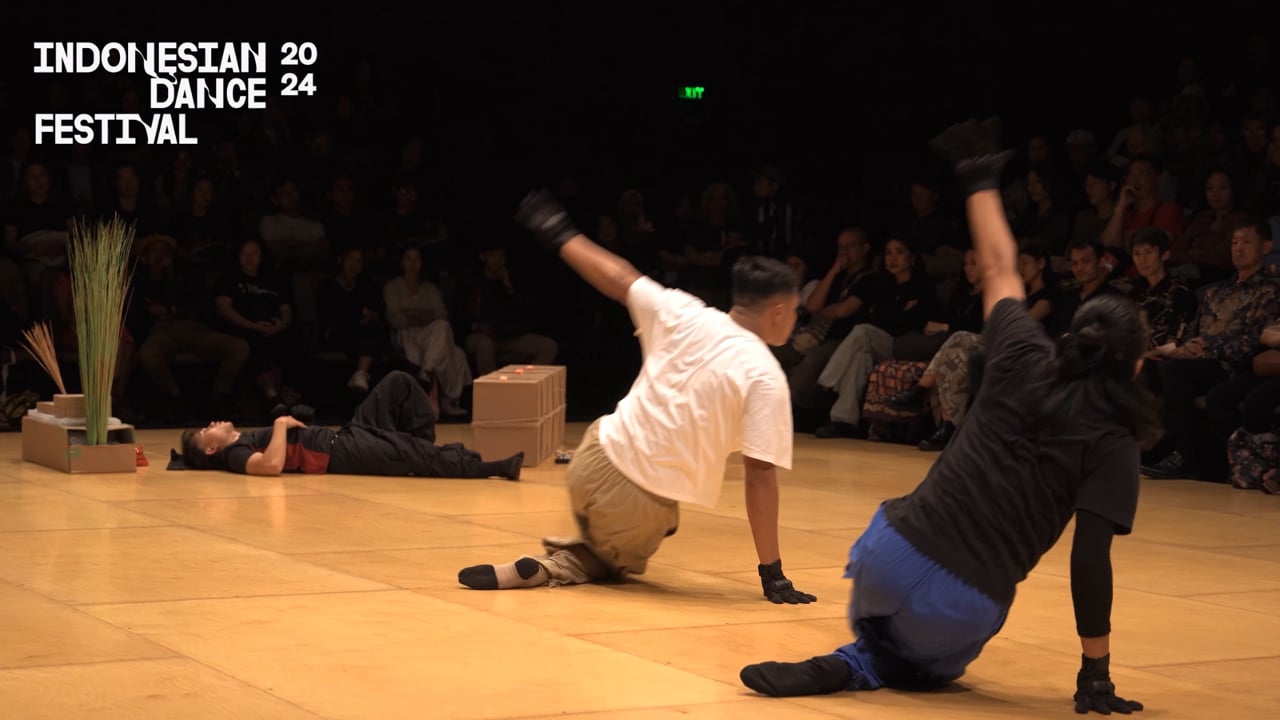
Drawing on their lived experiences and personal accounts collected across Japan and Indonesia, five performers generate a magnetic force through sweat and endurance. Over the course of an hour, their bodies become a living testimony to inundation and seismic rupture. They unfold a hypnotic, rhythm-driven choreography that transports the audience into a state at once meditative and explosive. Presented this year for the first time in Europe, RIDDEN swings between dance, ritual, sport, and band performance, sharing an ecological reflection on the absurdity of perpetual survival.
RIDDEN
First of all, Mio and I want to acknowledge that RIDDEN is our first major work. Over the past few years, we’ve been developing it little by little, collecting material fragment by fragment, exchanging ideas, and receiving feedback from people, including through a series of work-in-progress presentations across multiple cities in Asia. All of this really helped shape the direction of the work, culminating in its premiere at the Indonesian Dance Festival 2024 in Jakarta.
The starting point traces back to 28 September 2018, when a triple disaster—earthquake, liquefaction, and tsunami—struck Central Sulawesi, Indonesia. At that moment, I was not there. I was in Sorong, in Southwest Papua, for a hip-hop event, and I learned about this incident after some friends ran to inform me. The shutdown of communication networks there prevented me from contacting my friends and family.
In those days of uncertainty, I found myself drawn away from the city. I spent time at sea with my Papuan friend’s family, who are fishermen. Sitting on a small wooden boat, surrounded by the vastness of the ocean, I surrendered to the rhythmic rise and fall of the waves, drifting and repeating. I stayed with a situation that could not yet be grasped, while contemplating my hometown.
Six months later, in 2019, I returned to Palu and the city was still in flux. Signs of disruption were everywhere: stores and warehouses were looted, some donations were smuggled, trees and road signs collided with houses, and people had become sensitive to any kind of sound.
Beyond what was widely reported, I encountered the aftermath of liquefaction, which is rarely discussed. In the west and east of Palu, there was a large area where the ground had lost its solidity, transforming into an unstable surface. Our elders said: “A long time ago, these were water sites; former swamps and rivers.” They believed that these areas will reclaim their space once nature becomes unbalanced.
In these areas, with the soil still shifting between solid and liquid, I saw dangerous survival strategies emerge spontaneously: people dug for lost treasures buried under the ruins. Some found gold, mobile phones, antique stuff, and even ATM machines. But there was an unexpected day, when, accidentally, that activity coincided with various religious groups praying. The landscape no longer appeared as a clear separation between survival and ritual; the two were entangled. While people still carried their state of readiness, they carefully entered the area checking on the bouncy-bouncy ground with every step before starting to dig. At some point, gongs rang, people were chanting, prayers for the dead were spoken, followed by the word “aamiin” (amen).
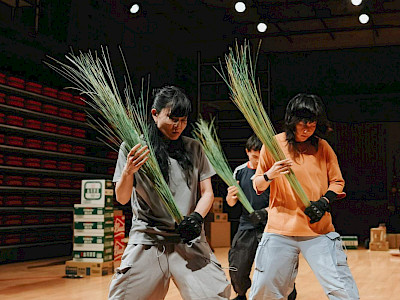
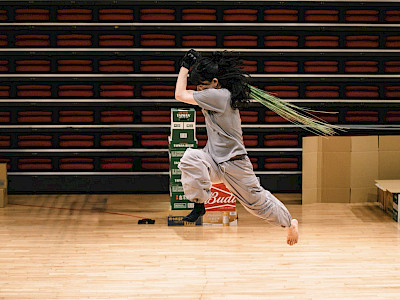
In another area, designated as safer ground, a different rhythm was present. People were cleaning, rebuilding, reorganizing space. There, the sound was very chaotic, echoing, layered and sustaining. One recurring element was the use of broomsticks, everyday tools made from a bunch of dried coconut branches. They are common in Indonesia, used to clean both inside and outside of the house, and sometimes even as roofing material. In some cultural beliefs, they can be used to ward off ghosts or bad spirits. And broomsticks also often appear in large public demonstrations, especially when held upside down by women or “ibu-ibu” (mothers).
I began developing this material in 2020, in my hometown, where I transformed my dining room into a small studio during the COVID-19 period. At that stage, the intention was simply to document those experiences and observations through dance. I grew up in the Indonesian dance context and came to realize that many traditional dances carry time, place, ethics, politics, events, and values. Not as fixed representations, but as fluid dimensions that continue to evolve.
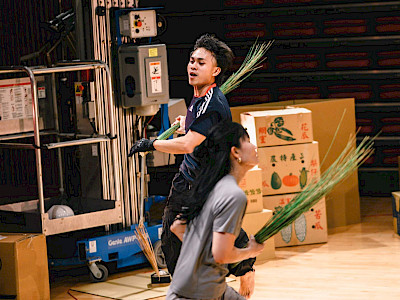
The work expanded further through the collaboration with dance artist Mio Ishida. We first met in Tokyo in 2021. Since then, the process has unfolded through both in-person and remote exchanges, communicating with each other through our broken English. Mio’s interest lies in designing activities that we can discuss and carry out together, whether resonating directly or indirectly with the project, as long as they have the potential to support its development. This includes conducting movement research in person, whether in Japan or Indonesia. She also introduced cardboard to our conversation, which in Japan is a popular eco-friendly and cost-effective disaster response as temporary shelter and emergency furniture. For example, it can become a bed, table, storage, or partition in an evacuation center.
Mio wrote in her diary: “My relationship with broomsticks was very strange at first, because Japanese broomsticks are typically made of bamboo. But gradually they feel like extensions of my body, and I begin to see them as musical instruments too.” She also wrote: “I’m struggling to remember everything, since we generate the movement and the music at the same time, so I start writing it down, much like onomatopoeia.” These approaches shifted our understanding from rehearsing towards generating movement, sounds, and improvisation simultaneously through writing, allowing us to work with very limited production resources.
Throughout the creative process, the work continued to evolve across different bodies and disciplines, from dancers, actors, and visual artists to musicians, as well as through exchanges with friends. Originally, the project was called The Museum. This shifted after encountering Boris Charmatz’s idea of the body as a “living archive” in the book Das Jahrhundert des Tanzes / The Century of Dance, during my visits to the home of Helly Minarti (an Indonesian dance researcher and curator) in Yogyakarta. At the same time, I began to question the concept of the museum itself, the history and structures behind it, and its distance from my own context. The title no longer felt like a match, as the process we were working with was breathable, unstable, and constantly moving. So we decided to change to RIDDEN. In Bahasa Indonesia, this translates as “ditunggangi” and in Japanese as “瑂鋋 / Hyoui”, a word associated with foreign spirits or ghosts inhabiting, living within, and moving together with the body.
- Leu Wijee
- Proofread by Jason Wrubell
Presentation: Kunstenfestivaldesarts, Théâtre Les Tanneurs
Performance: Bade Arrasyid, Dani S Budiman, Leu Wijee, Mio Ishida, Rheza Oktavia | Choreography, concept and directed by: Leu Wijee | Co-researcher and collaborator: Mio Ishida | Scenography: Leu Wijee & Mio Ishida
Production: wijeesworks | Coproduction: Indonesian Dance Festival
The artistic research for this performance has been supported by Jakarta Arts Council, Jakpro, Jakarta International Contemporary Dance Festival, Japan Foundation Jakarta, Kobalt Works, Indonesian Dance Festival (as part of Indonesian Dance Festival 2024), Toko Seniman (as part of Dalam Seniman artist in residence 2024), Taipei Performing Arts Center (as part of ADAM - Asia Discovers Asia Meeting for Contemporary Performance / Kitchen 2023), Taitung County Government (as part of Taitung Fringe Festival 2023), Ministry of Education, Culture, Research and Technology of Indonesia (as part of Ngetest 2023), Indonesian Dance Festival in collaboration with Japan Foundation Jakarta (as part of Kampana of Indonesian Dance Festival 2022), Asia Performing Arts Farm (as part of workshop Farm-Lab Exhibition Tokyo 2021), Salihara Arts Center (as part of Helatari 2021) and Jakarta Arts Council (as part of Upcoming Choreographer VS Koreografi Tari 2020). Special thanks to many friends and communities in Chigasaki, Jakarta, Palu, Papua, Taipei, Taitung and Yogyakarta who have generously and critically responded to the development of the work.