28 — 30.05.2026

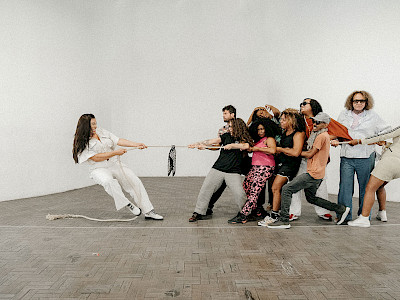
MEXA began in a shelter for unhoused people in São Paulo that hosted up to thirty residents. In this forced cohabitation under constant surveillance, new people would arrive while others were expelled for breaking the rules. In their decade together, MEXA has undergone changes, but still grapples with these turbulent origins.
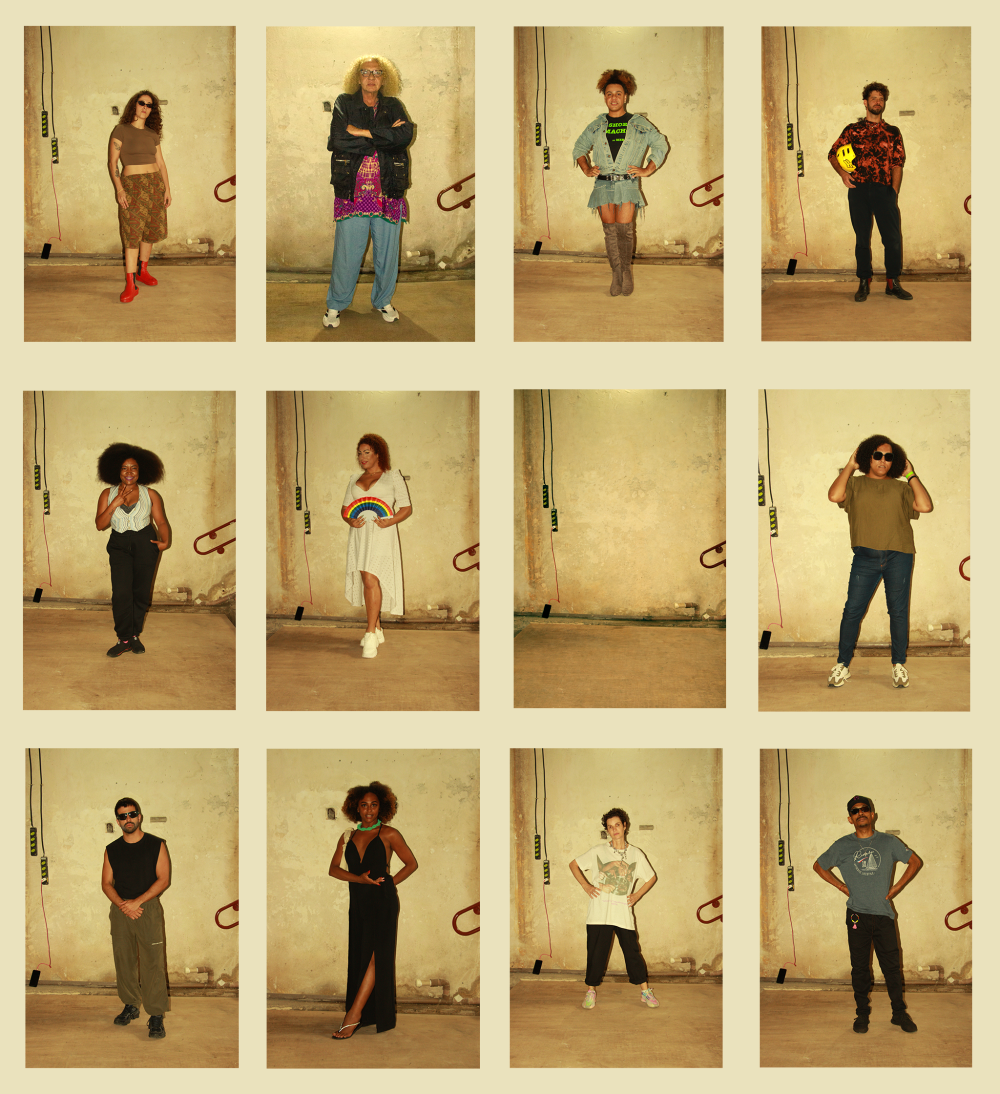
In Reality Show, ten performers inhabit a mutable space that evokes both a home and a film set, where furniture and cameras gradually appear on stage, and real-time projections are edited live. The familiar grammar of reality TV—of which MEXA’s members are devoted fans—mirrors their past experience of collective living and their present life in theatre. It evokes visibility without power, glamour entwined with exhaustion, and intimacy turned into transaction.
Through a game of elimination, MEXA reflects on how they have at times accentuated precarity to access the theatre circuit. What narratives are expected from a group shaped by instability? Are stories of hardship and scarcity the ones most likely to “win the show”? Do we all use fiction to find acceptance? After two acclaimed works, MEXA returns to the festival with a premiere of one of their earliest dreams. Reality Show is a sharp and exuberant depiction of a decade-long struggle for housing, visibility, and recognition.
REALITY SHOW
You are the first to enter the house
The furniture is already all there as if on a set
And you don’t know whether you’re allowed to sit on the couch
On the chair step into the pool
you pretend this is the happiest day of your life and by pretending so much, you smile and celebrate
Out of the corners of your eyes, you look for cameras and, without looking straight at them, yet in a way that lets them catch your face, you cry that is to say a few tears fall because you finally have a house and this is a lot
other people begin to enter this space and you realize you might know them, even if you’ve never heard their stories
But something strange is happening
Little by little, you realize you are being watched because you can hear the laughter, the applause and, above all, the silences from outside, though you cannot see anything
And your greatest fear is not to be trapped forever
But that the house might disappear and you would have to step out into a world where no one speaks your language
But for now, this is only the first scene of the first day
And you still have a house
Stage-time
And an audience
Now is when your reality is about to begin
For ten years, MEXA has been trying to retell its own story. At the first meeting of the group that I attended, I remember the unbelievable monologue of an actress about the time she killed her abusive husband and had to survive the horrors of prison. She cried, so did we. At the end, she said: “But this is not something I lived. It’s a friend’s story, who loves theater very much, but couldn’t come, so I wanted at least her life to be here.”
A decade later, the narratives have changed, but the way of approaching them, not so much. The stage has always been, for the group, a space of self-fulfilling prophecies: by repeating them enough, they may become true. Thus, the theater of the real that we have been investigating sometimes moves in a direction opposite to what one might expect: the world invades the theater, of course, but above all it is the theater that rewrites the world.
Reality Show is one of our oldest desires and, perhaps precisely because of that, it is the piece that has taken us the longest to make. It is the final part of our Trilogy of the Real, preceded by Pumpitopera Transatlantica and The Last Supper (all of them, fortunately for us, premiered here at Kunstenfestivaldesarts, under the attentive curatorial eyes and ears of Daniel Blanga Gubbay and Dries Douibi).
With this piece, we seek to face the theme that is perhaps most dear to the collective: housing. Emerging in the context of shelter homes, one of MEXA’s central questions has always been how to create anything when one does not have a house. Our meeting place, Casa do Povo, an independent cultural institution in São Paulo, where MEXA is one of the associated collectives, became, beyond a theater, a reference for a domestic space. It was there, between rehearsals and meetings, that we built an impermanent home. For as long as we were there, together, everybody had a place and this is both sad and happy at once. Sad because it always ends, but happy because we have, at least, a space to call our own.
In the same way, the stage gradually became the equiva-
lent of that temporary house. Every night it was built and dismantled, because the play ended and the world lasts longer than the theater. The fortunate thing is that the next day we might perform again. I know this is not an experience unique to MEXA. To be an artist is also to navigate between works and to exist in a partial way between one performance and another.
When thinking about the creation of this piece, the desire to build a house on stage emerged to materialize, in some sense, what the theatrical space had always represented for the group. And to do so through an investigation of reality shows, putting our autobiographical research in dialogue with this television genre that, in a way, has shaped the general perception of what it means to edit one’s own narrative in order to win a prize. Our prize had always been the possibility of continuing to perform and, for that, we were willing to do many things—including narrating our experience in a way that would fit into the audience’s interest. Is what we say really what we want to say, or do we say it to ensure that our stage-house continues to exist? And isn’t this a crisis shared by many artists?
And she stands there singing for money, La da dee, La dee da.
We were also interested in thinking about how, at the turn of modern theater, the idea of reality involved building on-stage prototypes of bourgeois houses. Characters came to be understood through the spaces they occupied and the objects they owned. To know them meant to closely examine the stage directions describing their rooms, books, wallpapers, pianos, carpets. If the house is the ultimate space of defining personality, how can we envision this within a group that creates from the absence of a house? What are the limits of this halfway-built house, without plumbing, fire, utilitarian objects, beds for everyone, without day or night, always the same spotlights, the same distance enforced by the fourth wall, the same texts and duration?
That is what we want to find out. And how good it is that we still have this night. This house. And this audience.
Welcome to the show of our lives. In the arena, there are nine characters in search of a character.
Only one of them will emerge as the winner.
Place your bets. And good luck.
- João Turchi
- João Turchi is a director, playwright, and screenwriter. He holds a master’s degree in dramaturgy from the University of São Paulo (USP), where his research focused on documentary and real theater. His projects unfold at the intersection of visual and performing arts, and he has collaborated with a wide range of artists and collectives, including Teatro da Vertigem, Barbara Wagner & Benjamin de Burca, and Marcelo Caetano. With MEXA, he directed and wrote works such as Pumpitopera Transatlantica, The Last Supper and Reality Show.
Presentation: Kunstenfestivaldesarts, Zinnema
Creation: MEXA | Direction and dramaturgy: João Turchi | Performers and co-creators: Aivan, Ale Tradução, Dourado, Laysa Elias, Lucas Heymanns, Ph Verissima, Podeserdesligado, Suzy Muniz, Tatiane Arcanjo, Veronika Verão | Research and direction assistance: Lucas Heymanns | Sound design and original music: Podeserdesligado | Video performer, video creation and technical direction: Laysa Elias | Scenography: Vão | Lighting design and video installation: Bio Riff, Juliana Bucaretchi | Video operator: Fagner Lourenço | Lighting operator: Claudi | Production design: Lu Mugayar | Costume design: Anuro Anuro, Cacau Francisco | Graphic design and visual identity: Margem | Production coordination: Francesca Tedeschi/Casa do Povo | Original song: Dourado | Choreography: Alexandre Paulikevitch | Dramaturgical collaboration: Julia Pedreira
Production: MEXA | Coproduction: Kunstenfestivaldesarts, Festival d'Automne à Paris, Casa do Povo, Sophiensaele | With the support of Kaserne Basel, São Paulo Biennial
Thanks to Guilherme Giufrida, Esponja, Marcela Amaral, Benjamin Seroussi and the Casa do Povo team
MEXA Group has been an associated collective of Casa do Povo since 2016.