14 — 17.05.2026
Marlene Monteiro Freitas Mindelo-Lisbon
NÔT
dance


 | ⧖ 1h30 | €25/ €20 | Contains flashing lights and strobe effects
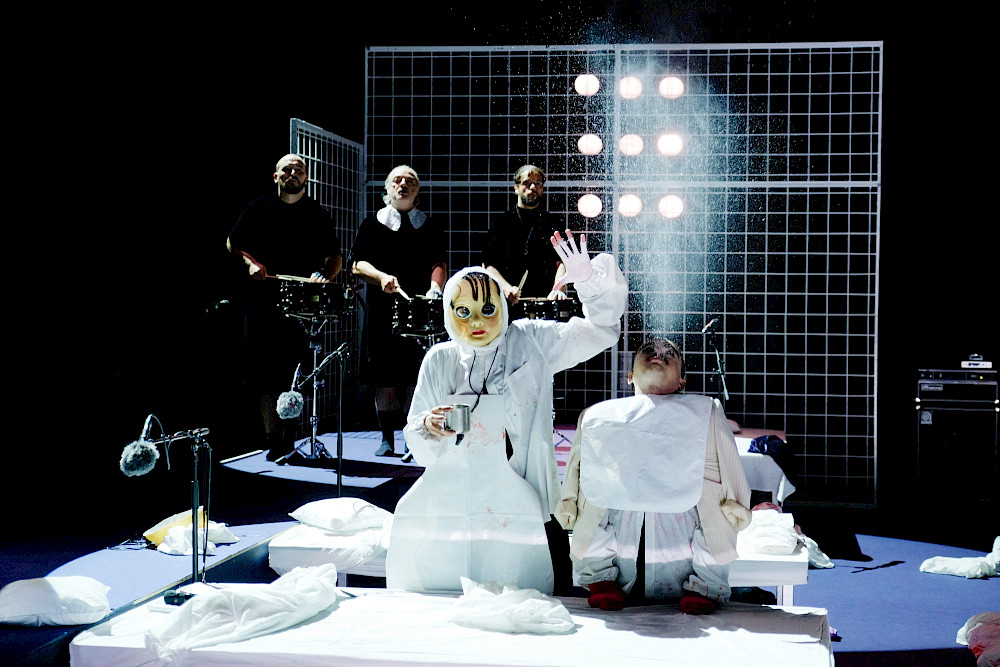
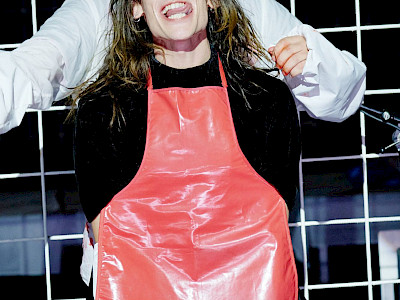
On stage are white fences and unmade beds. Eight performers, at the same time dancers and drummers, bring this strange, frenzied and liberating fable to life. For NÔT – "night" in Cape Verdean Creole – Marlene Monteiro Freitas drew inspiration from the tales of One Thousand and One Nights: stories about love, freedom and war. She uses the ambiguity present in these stories as a creative engine for a performance that once again showcases her unique choreographic style: intense performative presence, powerful aesthetics, grotesque and carnivalesque elements, fragmented movements, nonsensical language.
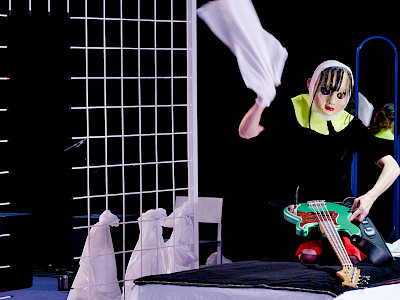
Monteiro Freitas creates a chaotic world ruled by (patriarchal) terror, in which movements arise from obedience and coercion. For the first time, she works with masks, placing even more emphasis on the expressive physicality of the performers. The overwhelming soundtrack, with live drums, sets the rhythm of the performance and brings even more chaos. NÔT unfolds as an artefact of multiplication, projection, alienation and enchantment. It is a disruptive, explosive, and energetic spectacle, both in form and content. How to survive when you can only rely on yourself? Will we make it through the night?
"Enough to wake the wildest dreams and fantasies", Agnès Izrine, 2025, La Terrasse
"An inventive and delirious envisioning of the Thousand and One Nights.", Fabienne Pascaud, 2025, Télérama
Interview with Marlene Monteiro Freitas
Wilson Le Personnic – Your work regularly incorporates ambiguous characters and bodies affected by conflicting tensions, in a dream-like, brutal, and sometimes burlesque universe. Do you picture the stage as a political space, somewhere to observe and experience the tensions of the contemporary world?
Marlene Monteiro Freitas – I am always attentive to the way that the bodies, figures and situations we construct reveal something of the human condition. For me, that is a constant stimulus. We are trying to open up spaces where tensions, contradictions, and excesses can exist without having to try at once to explain or control them. In my pieces, the bodies are affected by forces and impulses. Even when they appear subject to constraint, they always keep a space for play and pleasure, between restraint and overflow. And when gestures are loaded with tension or violence, freedom and enjoyment still pervade them. That is what interests us, that capacity to pass from one state into another, to resist or to transform a restriction into material for play. We seek to create contexts that allow movement into more intense, more extreme, and more ambiguous states. From their side, the spectator projects their own imagination into these situations, and it is there that a political reading may often emerge. Between what we offer on stage and what each person perceives, a fertile space opens up in which several truths can coexist. To me, that is where the power of theatre lies; in that what is uncontrollable, ungraspable.
Can you share some of the questions and reflections which were drivers for NÔT?
Borges wrote that One Thousand and One Nights “adds one night to the infinity of nights.” In turn, we are inventing our own tale, our night, our dream. The night changes the way we perceive the world: it brings up other images, similar to those of dreams and stories. It opens up a space between identity and otherness, where time is distorted, drawn out, reformed, and where markers are moved, sometimes even overturned. The vertiginous structure of One Thousand and One Nights, with its nested tales of different lengths and with disparate characters, relates closely to the dream world. The violence of the framing tale appealed to us especially: the blood of virginity, of wounds, the threat of death, confronting the logic of survival. The idea of surviving through fiction, protecting a living space with the imaginary, was one of the essential drivers for the piece. The works of Jamel Eddine Bencheikh, especially Les Mille et Une Nuits ou la parole prisonnière, as well as the work by Christiane Achour, Les Mille et Une Nuits et l’imaginaire du XXe siècle, have helped us to grasp the extent of the geographical, temporal, and stylistic reach of One Thousand and One Nights. They call into question the ideas of the finite, of originality, and of boundaries. This is a work which is continuously reinvented, crafted by the tension between the spoken and the written. A work affected by the constant struggle between law and desire, between the memory and the future, a real body of work subject to cutting and grafting, to amputation as well as expansion.
How have you transposed the ideas, the images, the stories, or the imaginary world of One Thousand and One Nights into the studio? Can you give us a picture of the choreography process?
We started from some very specific elements taken from One Thousand and One Nights. Some materials came directly from the tales, but these were quickly transformed to become tools of choreography, rather than simply narrative elements. I focused first on research around issues of scale, working from miniature figures. Many of the stories evoke changes of size, bodies shrinking, enclosed or metamorphosed. These experiments opened up work on unaccustomed proportions and dynamics of movement. Alongside this, we developed research working from objects associated with night-time and intimacy, such as beds, sheets, and pillowcases. These elements served to clean, disguise, and mask, or else as bags kept close to the players throughout the piece. Gestures of folding, covering, transporting, unfolding, as well as matters of bodily hygiene and space, structured a significant part of the work. Some specific fragments from the tales were also used as entry points into the work. A situation, a gesture, or a symbolic detail became a possible search path. These elements were not preserved as such, but they first fed into a shared vocabulary, before being transformed or absorbed into other materials. It therefore wasn’t a matter of adapting a story, but rather of extracting images, actions, and rhythms from it in order to transpose them into physical, that is rhythmical, situations. Through this accumulation and through gradual adjustments, a world gradually appeared in an outline, with its own logic, its tensions, desires, and needs.
In NÔT, music and sound play an essential role, since they act as a real dramaturgical force. Can you share some of the musical/sound material, and address the importance of music in your creative process?
I often begin by gathering a great deal of musical material, without knowing which parts of it will be kept. As the work proceeds, some pieces are seen as essential, others disappear, and the soundtrack is put together as a parallel strand to the choreography. NÔT did not escape this process: the heterogeneous soundtrack was really composed at the same time as the piece itself. It deliberately gathers together some very disparate references. In particular, it includes Les Noces by Igor Stravinsky (tale of a wedding), Diallo by Wyclef Jean and Youssou N’Dour (story of the assassination of a Guinean student in the United States), The Mercy Seat by Nick Cave (account of a man condemned to death), Rotcha Scribida by Amândio Cabral (lament for the death of a mother), Delgadina by Juan Barquillas (story of a young woman imprisoned by her father’s incestuous love), Berber wedding music from Tinghir province, a trance ritual from the Aissawa of Fez, as well as Symphony n°8 by Gustav Mahler (often associated with the idea of redemption through love). For the live music, I wanted to work with snare drums, able to both spread their vibrations widely, and to produce strong, precise percussion. This instrument brings with it an ambiguity which particularly interests me, with its festive, military, and funeral registers. In the piece, we also play with glasses, empty plates, and small knives—referring to the ferrinho, a traditional instrument of Cape Verde—which gradually emerge as real choreographical tools, especially with the appearance of one character in the studio: the surgeon-cook. Music and sound act on bodies, on perceptions, and on feelings. Each source contributes its own colour, its power, its suspense, its vocal density, or its vibration. It establishes the conditions for listening and attention that transform movement, and perhaps occasionally counter it with a voluntary resistance.
How have you envisaged the space for NÔT?
Rather than presenting an identifiable space, the idea was to create a functional, modulable framework that can be interpreted in different ways. We have worked with fences that organise the space into zones of passage, of separation, of control, or of waiting, in an uncertain environment, where one does not know if one is coming or going, or if one is waiting for something. They restrict the bodies, divide the space, while remaining transparent, open to the imagination: the arrangement may evoke a dolls’ house, a bedroom, a hospital, a detention centre, a border, a dream space, etc. This space has been conceived with Yannick Fouassier, with the collaboration of Francisco Rolo and Emma Kaci.
- Excerpts from an interview by Wilson Le Personnic, January 2026
- Translated by Joanna Waller
Wilson Le Personnic is a freelance writer and arts practitioner. He works closely with artists in the field of choreography, supporting their creative processes or documenting their approaches. He also writes for the media, cultural institutions, and artistic projects, producing critical, editorial, and outreach texts.
Presentation: Kunstenfestivaldesarts, Kaaitheater, Théâtre National
Choreography: Marlene Monteiro Freitas | Choreography assistance: Francisco Rolo | With: Ben Green, Henri “Cookie” Lesguillier, Joãozinho da Costa, Mariana Tembe, Marie Albert, Miguel Filipe, Rui Paixão, Tomás Moital | Set design: Yannick Fouassier, MMF | Lights and technical direction: Yannick Fouassier | Costumes: MMF, Marisa Escaleira | Sound: Rui Antunes | Stage management: Ana Luísa Novais | Special stage prop: Cláudio Silva | Set design internship: Emma Ait-Kaci | Artistic consultancy: João Figueira, Martin Valdés-Stauber | Production and diffusion: P.OR.K | Managing director: Rui Silveira - Something Great | Tour production manager: Niki Fischer - Something Great | Administration and production management of the creation: Janine Lages | Diffusion (until 2025): Key Performance
Coproduction: Kunstenfestivaldesarts, Festival d’Avignon, Berliner Festspiele, Kampnagel International Summer Festival, Culturgest, MC2 - Maison de la Culture de Grenoble, Le Quartz, La Comédie de Clermont-Ferrand, Maison de la danse Lyon, La Villette, La Comédie de Genève & La Bâtie - Festival de Genève, Onassis STEGI, Teatro Municipal do Porto, PACT Zollverein
Residencies: O Espaço do Tempo, Alkantara, OPART, E.P.E./ESTÚDIOS VICTOR CÓRDON, Onassis AiR, MC2 - Maison de la Culture de Grenoble, Kampnagel International Summer Festival
Institutional support: Dançando com a Diferença | Acknowledgements: Carlos Duarte, Atelier MC2 Grenoble | The dramaturgical research of NÔT was supported by Onassis AiR in 2025