14 — 16.05.2009
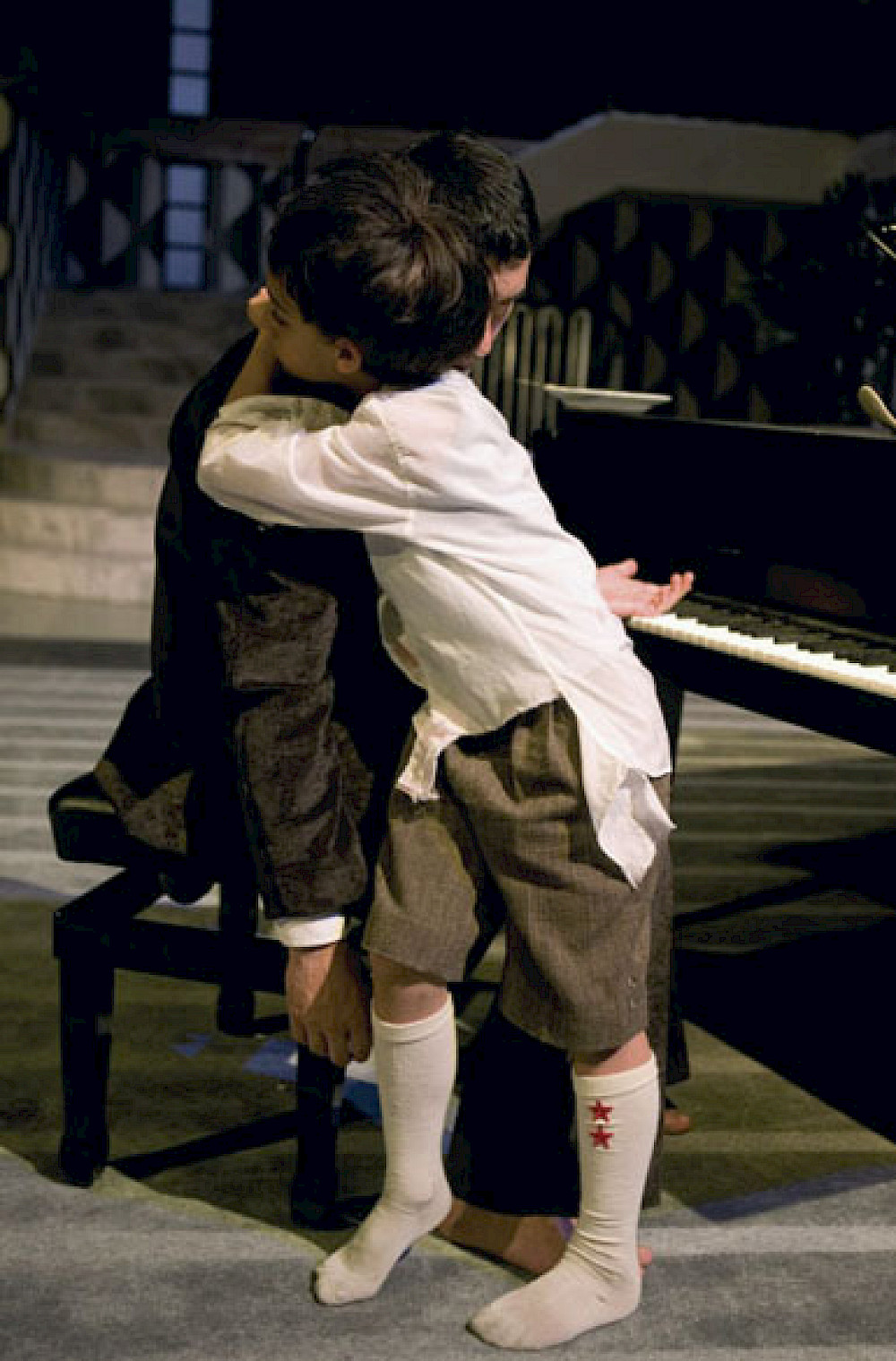
Together with deSingel and La Monnaie, the Kunstenfestivaldesarts is offering Brussels audiences a unique opportunity to see Castellucci’s trilogy, an adaptation of Dante’s Divine Comedy, as a whole. In contrast to the sensational world of Inferno, Romeo Castellucci’s Purgatorio takes a much more naturalist approach. “If the world is bound for damnation, it’s our fault”, wrote Dante. In Purgatorio the absolute evil lies at the heart of the family, with a father, a mother and a son as the only protagonists. To give shape to the machinations of evil, this Italian director makes avid use of the machinery of the stage. He treats the audience to an impressive and hyperrealistic set; the middle-class interior of a stately house from the 70s. There is a feverish atmosphere in the room, a constant menace... that barely stops short of suffocating the occupants. In Purgatorio, Romeo Castellucci has produced his masterpiece, said Le Monde when the trilogy premiered at the Avignon Festival last summer.
The need for blasphemy - initial notes on Purgatory
by Claudia Castellucci
Purgatory is not the place where the son - waiting to be received into Paradise - receives atonement. Rather, it is the place where the father reveals what a disastrous failure his self-sufficient power has been and where, feeling a great need to come out of himself, he attempts to make his son feel compassion for him.
The father pushes at the limits of what he has brought to a close and makes a creature that will always be his, but destined for another body, another sensation, another mind and another direction.
The silent sorrow of the father: the fear now is not just of being himself, but of being separated from his son. And again sorrow is not enough: once again boundaries have to be pushed and his own creature violated in order to have faith in consolation, the last feeling that father and the son can ever experience together.
The father hopes to be comforted, but this hope will be more intense if the evil committed is more clear-cut and unforgivable.
The evil is life. The first evil, the original sin, is the fact that the father has given life to his son. The father must be forgiven for this. And the violation is a dreadful flashback rushing into the night with self crushing self if the son does not save and console the father. This is why blasphemy is tinged with gentleness: anyone can be the subject of blasphemy, but not the person doing the consoling.
It is not enough for the father to feel pain like an animal: he needs to be consoled.
All animals experience pain, but none feels the need to ask for consolation or to delegate his pain to another.
This Purgatory is seen from the reverse perspective of God, and will need to be interpreted from end to beginning if we want to grasp its truth which, while definitely very human, can also be theological. We will be substituting the word God with the word Father. This is what we will be concerning ourselves with from now on.
In the stages of creation, the father creates the son on the last day when he is already weary from all his hard work. The father creates him in his image but does not say about him, as he did with all the other creatures, "it is very good". But if the resemblance is not "good", then the reason must be found in the first contraction of a father who, as long as he does not come out of himself while creating, dreams up a feeling of self-embarrassed reality.
The father needs the son, but then he needs to break a relationship whose symbiosis threatens to reconstitute the ending from which he wanted to extricate himself. The son really does need to be autonomous, but in order for this autonomy not to become abandon, an act is required that is both a revocation and an appeal: the act of violating the son produces hope of consolation, the link between separation and love.
The power of the father swoops down on the innocence of the son to invoke his consolation; in other words, sharing the disaster. I created you, forgive me, and help me carry the burden of it. Consolation is about sharing the terrible reality of life, and the hope of receiving consolation will be stronger if the violence shown towards life is more unforgivable.
Consolation is what the very powerful father wants, represented here in the form of an upper middle-class manager living in luxury. The violation is not committed in an environment of want and social lowliness, but at the height of success. But to dispel any socio-anthropological misunderstanding, the metaphor tells us here that man, the son, is not created in indeterminate shadows, in the image of God, but as the entire Garden of Eden luxuriantly flourishes.
The son is a kind of fatal mistake appearing during a period of distracted weariness after all the hard work. The son is perhaps the outcome of complacency, but one which demands to be turned into a spectacle for different eyes. The son will be destined to reflect the image of the father forever and will always reproduce this initial need to look and look again. This is the original sin that has to be attributed to the father and not to the son.
The father will violate his son after making him climb the stairs. It is about a journey the other way round, leading him to encounter his beginnings. The staircase here is also a symbol of ascending to the place of sacrifice, of climbing Mount Moriah where Isaac went to be sacrificed by Abraham, his father, had the angel not intervened to stop his hand a moment before his throat was cut. Like Abraham, the father prepares himself, carrying with him the instruments of sacrifice. But here the sacrifice is committed for him and there is no angel to intervene and stop the father. Moriah will not become the mountain of the "Lord Provider" (Genesis, XXII, 2) because here it is about the father, a father who can no longer provide for himself because he is in need of consolation.
The need for consolation changes the colours of Purgatory in the blasphemous transposition of the father as the sinner, and this is why the father needs consolation.
Thus Purgatory as a place manifesting the terrifying point of view of the father who directs his thoughts towards creation until there is a blind inculcation of the self into the self, where the "I am" no longer detects anything, not even himself, and where as yet no language exists.
Particular attention needs to be paid here to the inscriptions projected on stage, inscriptions that call silent movies to mind - as well as a renewed and ontological need to see in silence - as much as they do the principle of any discourse whose origins are not yet in language form and where the writing is responsible for expressing it. In this sense, the writing precedes the spoken word and language is created by translating writing into sounds and not vice versa.
The father comes back down the staircase and collapses after having committed his crime. The son sees him and takes the father's weight on his shoulders (he is the one who will have to create from now on) by announcing the end of time. "Don't despair. Everything is done." This apocalyptic appeal already heralds Paradise. Heaven and earth no longer exist. There will be a new heaven and a new earth. The evil you have made has completely disappeared. The reality that you created will be rewound like a roll of film.
From then on the son, about whom it has not yet been said that he is an ignorant and innocent child, starts to unwind the paternal reality of creation, moving through it from end to start, seeing again and recapping the Garden of Eden with its flowers that walk like animals before the sky and the moving clouds. The vision is monocular, as if to confirm the division between colours and the darkness which envelope the polychrome globe of all forms. The son moves from the end through the days of the father's creation all the way to its beginnings, sharing with him the why of reality, the why of its contraction, the why things happen without reason, and it is only afterwards that we try to attribute causes for them, without managing to grasp their true meaning, even by postponing it.
After creating the world the wrong way round, and thus leading us to Paradise, we see the consolation realised and even shared. Now the father has the trembling legs of a newborn, disappearing into the beginnings of time. The shadow of the son lengthens over the father who is more of a child stretched out on the ground and, like a shadow atoning for the violation, will reproduce the multidirectional movement of the trembling of a newborn.
The consoling son, like a disarticulated puppet, tries everything possible to save the father. The effect is one of continual movement without abandoning his position, the very same one in which the father finds himself. Jumping on the spot is not moving from one point to another in the space, but moving in time, it is the duration of the life in a place where one has already arrived because it is one's very own. It means he is ready for Paradise.
Claudia Castellucci, Senigallia, 12 June 2008
Claudia Castellucci is the founder of Socìetas Raffaello Sanzio alongside her brother Romeo Castellucci and Chiara Guidi. She deals with the corollary theory of the Socìetas' productions and show programmes, and arranges seminars and conferences in the Teatro Comandini, the Company's base and place of work. She founded and continues to run Stoa, a school of rhythmic movement based in Cesena since 2003.
She has written and published works such as Il teatro della Socìetas Raffaello Sanzio, dal teatro iconoclasta alla super-icona, Ubulibri edizioni, Milan, 1992; Uovo di bocca. Scritti lirici e drammatici, edizioni Bollati Boringhieri, Turin, 2000; Epopea della polvere, Ubulibri edizioni, Milan, 2001; Les Pèlerins de la matière,
théorie et praxis du théâtre, Les Solitaires Intempestifs, 2001; and The Theatre of Socìetas Raffaello Sanzio, Routledge, London and New York, 2007.
La Divina Commedia
by Antoine de Baecque
The Divine Comedy is a sacred poem by the Florentine poet Dante Alighieri (1265-1321) and comprises three parts - Inferno (Hell), Purgatorio (Purgatory) and Paradiso (Paradise) - each with thirty-three cantos plus an additional introductory canto. Written between 1307 and 1319 towards the end of his life, it was with a sense of relief and some melancholy that Dante completed this work of one hundred cantos and close to 15,000 lines. The Divine Comedy was composed at the time the papacy came to Avignon and the first Palais des Papes was built. For western culture, it is more than just a literary monument; it is a reference work. Even for those who have never read it, the work makes sense. It is like a mythical country - we visit its underworld and fear its troubles, we travel through paradise and hope for its delights. Its images, visions and hallucinations and the range of registers (including love, mysticism, learning, allegory, politics and poetry) have also been a source of fascination for numerous writers and artists: many of them - Dumas, Stendhal, Baudelaire, Nerval and Lautréamont to name but a few - have translated it to appreciate its richness fully. Romeo Castellucci is now seeking to "transpose The Divine Comedy to the stage", offering audiences an opportunity to work their way through its three stages at three different Festival venues and experience a Divine Comedy.
Direction, set design, lighting & costumes
Romeo Castellucci
With
Irena Radmanovic, Pier Paolo Zimmermann, Sergio Scarlatella, Juri Roverato, Davide Savorani
Choreography
Cindy Van Acker, Romeo Castellucci
Original Music
Scott Gibbons
Collaboration to the set Design
Giacomo Strada
Sculptures on stage, mechanisms & prosthesis
Istvan Zimmermann, Giovanna Amoroso
Automations
Giuseppe Contini
Images
ZAPRUDER filmmakersgroup
Presentation
Théâtre National de la Communauté française de Belgique, De Munt / La Monnaie, Kunstenfestivaldesarts
Production
Socìetas Raffaello Sanzio
Coproduction
Festival d’Avignon, Le Maillon-Théâtre de Strasbourg, Théâtre Auditorium de Poitiers–Scène Nationale, Opéra de Dijon, barbicanbite09 London, deSingel (Antwerp), De Munt/La Monnaie (Brussels), Athens Festival, UCLA Live (Los Angeles), La Bâtie (Genève), Emilia Romagna Teatro Fondazione (Modena), Nam June Paik Art Center/Gyeonggi-do, Korea, Vilnius – European Capital of Culture 09, Vilnius International Theatre Festival Sirenos, Cankarjev dom / Ljubljana, F/T 09 Tokyo International Arts Festival, Kunstenfestivaldesarts
Thanks to
Comune di Senigallia-Assessorato alla Cultura / AMAT