30.04, 01.05.2009
Boris Charmatz, Musée de la danse Rennes
La danseuse malade
dance / performance
French → NL | ⧖ 1h10
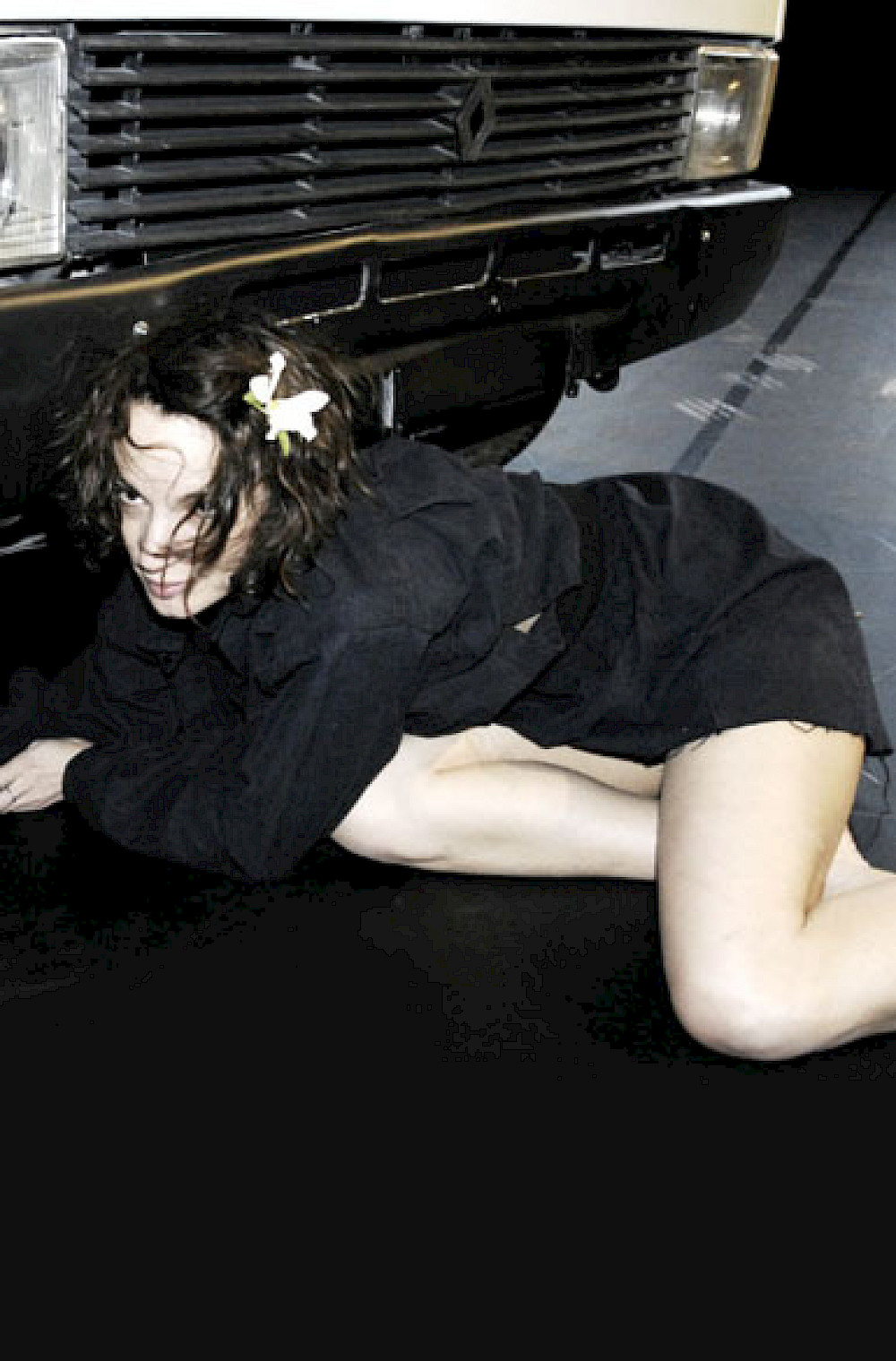
La danseuse malade is spectacular. A flame shoots up in the air; a head explodes. The eye-catcher on stage is a white truck that races round and round. Halfway through the performance, a mad dog appears on the scene. Few people would guess that in this piece Charmatz goes back to the essence of the Japanese Butoh dance, but this is precisely what he does. He found inspiration for La danseuse malade in a manifesto by the avant-garde artist Tatsumi Hijikata (1928-1986), one of the founders of Butoh. This "Dance of Darkness" has its roots in traditional Japanese theatre but breaks with the established rules. While it alludes to images of decay, fear and doubt, the dance is above all steeped in eroticism, ecstasy and stillness. In La danseuse malade, Boris Charmatz and Jeanne Balibar form a trio with the text, previously unpublished in the West. This French choreographer is unrivalled when it comes to translating the original power of text and dance into dark literary waves that force our gaze far beyond expectations and conventions.
La danseuse malade
To blind, perhaps to burn
La Danseuse malade, Boris Charmatz's latest performance, opens with a thunderous flash to the face. Dance can blind one, and burn one. It can be deceptive, too. Dance is not necessarily something pleasant.
A figure appears wearing a helmet and an overcoat, then a tunic, and later a coarse apron. Somewhere between an unreal apparition and everyday banality, between handicraft and clinical garb. The lighting, by Yves Godin, accentuates the sharp contrast in what is visible of the body's muscular tone. A short sequence shows a man's body in a state of martyred beauty, and more will follow. The bodies of dancers are not always heroic or harmonious.
A dance with a vehicle?
That bulky thing, there, turns out to be a vehicle. On stage. Bulky but here quite surreal, it will keep driving around on stage. A dance with a vehicle? In its movements, dance is an art that carries its load of memories, fears, dreams, joys, impulses, experiences, customs, cultures, passions, trainings, commitments, sufferings, inheritances, knowledge, codes. At the end, a dancer's body is often cut off from language. But it is never unaware of language. Dance feeds on forces that surpass it yet support it. Performance after performance, the aim of Boris Charmatz's ambitious choreographic project is to reveal it.
The actress behind the wheel
A vehicle is still a machine, something powerful, with its own logic. Charmatz gives up part of his movements, lets other forces do the work. A machine that overwhelms the artist's conscious control, that debunks the romantic myth of the demiurge's omnipotence towards his creation. And that limits, releases or provokes movement.
Charmatz is not alone. He is performing a duo with Jeanine Balibar: they attack the stage floor, rip up the carpet, mix up the scenic substance, a magma made up of rubber strings, almost viscous. A chilling convulsion is performed.
And then, suddenly, a change in intensity. Jeanine Balibar.
The actress. Behind the wheel. Framed. A lengthy monologue in a translucent voice, somewhat greyish. Given up to the swell of a text she is releasing from under its surface. She avoids all effects, underlines nothing, takes away rather, and moves towards the underlying layer, in the twilight of meaning, represented in a choreography of embedded imaginary frames that the dancer enters and that unfold on stage.
To hear-see Tatsumi Hijikata's texts
A silent reserve is necessary when encountering Tatsumi Hijikata's texts, to hear-see that which they lay bare and to gain clear passage through their dark literary commotion. And yet, what texts! And what a writer!
Hijikata was the founder of butoh. But we have to be clear about this. We have to dust off the at times beautiful, exotic, indeed decorative image with which the West has idolised this genre. We have to remember that it is a dance of darkness, but especially of the dark body; a dance that has fed on the feverish writings of the French surrealists, the authors from the dark side (Genet, Sade, Bataille). A dance that rebels against the domesticated forms of the main dance traditions, including the Japanese, this butoh chooses to make use of unspeakable archaisms, repulsed by the fusion of births and deaths, the burning of silenced cries, of anguished sexes, of abandoned children. Bodies inhabited by other bodies, some by corpses that need to die again.
The words pierce the dancer's attempt
Hijikata was both the author of these forces and their performer on stage. It is worth reading an extract from his writings, thanks to the capable skills of Patrick De Vos, a rare translator of these texts that are unpublished in the West:
"I look at the hands. A movement of particles escapes from them. The spinal column leans slightly forward. A dance runs down the incline. One unfortunate gaze means one will receive a different gelatine. Burning heads. Revenge, kept in check by a cold button, has lowered its forehead somewhat; the material should first be a lover. I move closer. The smell triggers an almost ascetic balance between the boys and myself; generally, all these bodies that are stretched to their utter limit like umbrella ribs to hold something back that is falling, all these transverse bodies, breaking, stiffened by sacrifice, in many ways give preference to the almost standard lines of their twenty-something entourage, instead of all the seductive figures. In the huge city of Tokyo there are bodies that have to die." (Tastumi Hijikata, extract from "Inner Material")
The texts are not about butoh. Nor are they about dance, or Tastumi Hijikata. They are a dance, they are Hijikata's body. And his thoughts with his body.
Charmatz and Balibar do not form a duo in La Danseuse malade. Taken together they are a trio. The words pierce the dancer's many attempts, up to being bitten by threatening dogs. Dance? It can be a terrible thing.
Source: Théâtre de la Ville
Author: Gérard Mayen
BUTOH
Butoh first emerged in Japan in the wake of the Second World War. More specifically, with the performance of Kinjiki in 1959. It was a short play, with no music, and it provoked a huge scandal. A young man (Yoshito Ohno) suggests sex with a chicken by squeezing a chicken between his knees, after which Tatsumi Hijikata seeks to approach the boy. Butoh has since been called shocking, provocative, physical, spiritual, erotic, grotesque, violent, cosmic, nihilist, cathartic and mysterious.
The concept of ankoku butoh, later shortened to butoh, was introduced by Hijikata and means "dance of darkness". It is best described as a sum of elements from traditional Japanese theatre, Ausdrucktanz and mime. It breaks with the established (dance) rules and leaves much room for improvisation. Recurrent characteristics are the white painted bodies, the slow movements, the bald heads and contorted postures. The dance evokes images of decay, of fear and desparation, images of eroticism, ecstasy and stillness. Butoh was influenced by Ausdrucktanz, because in the twenties a number of Japanese dancers went to Gemany to study European dance. Upon their return to Japan, they founded ballet schools in which both Kazuo Ohno and Hijikata got their first lessons. Those two founding fathers of butoh met in 1954. It turned out to be the beginning of a longlasting collaboration, during which Hijikata would direct and choreograph many pieces for Ohno. Hijikata's studio became the centre of the butoh movement - insofar as one can speak of a movement, since there are in fact as many forms of butoh as there are dancers.
Choreography
Boris Charmatz
With
Jeanne Balibar, Boris Charmatz
Text
Tatsumi Hijikata
Translation
Patrick De Vos
Helmet performance devised and broadcasted by
Gwendoline Robin
Lighting design
Yves Godin
Light & video
Eric Houllier
Stage design
Alexandre Diaz, Dominique Bernard
Sound design
Olivier Renouf
Sound operator
Jacques Marcuse
Technical direction
Frédéric Vannieuwenhuyse
Set construction
Artefact
With the collaboration of
Françoise Meslé pour Jacana wildlife studio
Presentation
Théâtre National de la Communauté française, Kunstenfestivaldesarts
Production
Association edna (Paris), Musée de la danse / CCNRB (Rennes)
Production leader
Sandra Neuveut
Production assistant
Cécile Tonizzo
Coproduction
Théâtre de la Ville (Paris), Festival d’automne à Paris, CNDC (Angers), NTA (Angers), La Ménagerie de Verre (Paris), deSingel (Antwerp)
Authorized by
Buto Sôzô Shigen (Tokyo)
With the support of
ADC (Genève), Dampfzentrale (Bern), Gessnerallee (Zürich), Tanzquartier (Wien), Cultures France (Paris).
Thanks to
Marie-Thérèse Allier, Frédéric Bélier-Garcia, Lalou Benamirouche, Patrice Blais et Raoul Demans, Patrick De Vos, Myriam De Clopper, Marie Collin, Emmanuelle Huynh et toute l’équipe du CNDC d’Angers, Sima Khatami, Isabelle Launay, Aldo Lee, Frédéric Lormeaux, Barbara Manzetti, M. Marlhin (DPI), Takashi Morishita, Jean-Pihilippe Varin, Gérard Violette
Musée de la danse / Centre Chorégraphique National de Rennes et de Bretagne - Direction: Boris Charmatz - Association soutenue par le Ministère français de la Culture et de la Communication (Direction Régionale des Affaires Culturelles / Bretagne), la ville de Rennes, le Conseil régional de Bretagne et le Conseil général d'Ille-et-Vilaine.
Cultures France contributes regularly to the international touring of the Musée de la danse.